Request Your Custom Quote
Tell us what you need. Our team normally replies within one business day.
Honeycomb Packing Paper vs Bubble Wrap: What Each Does and When to Use It
 By
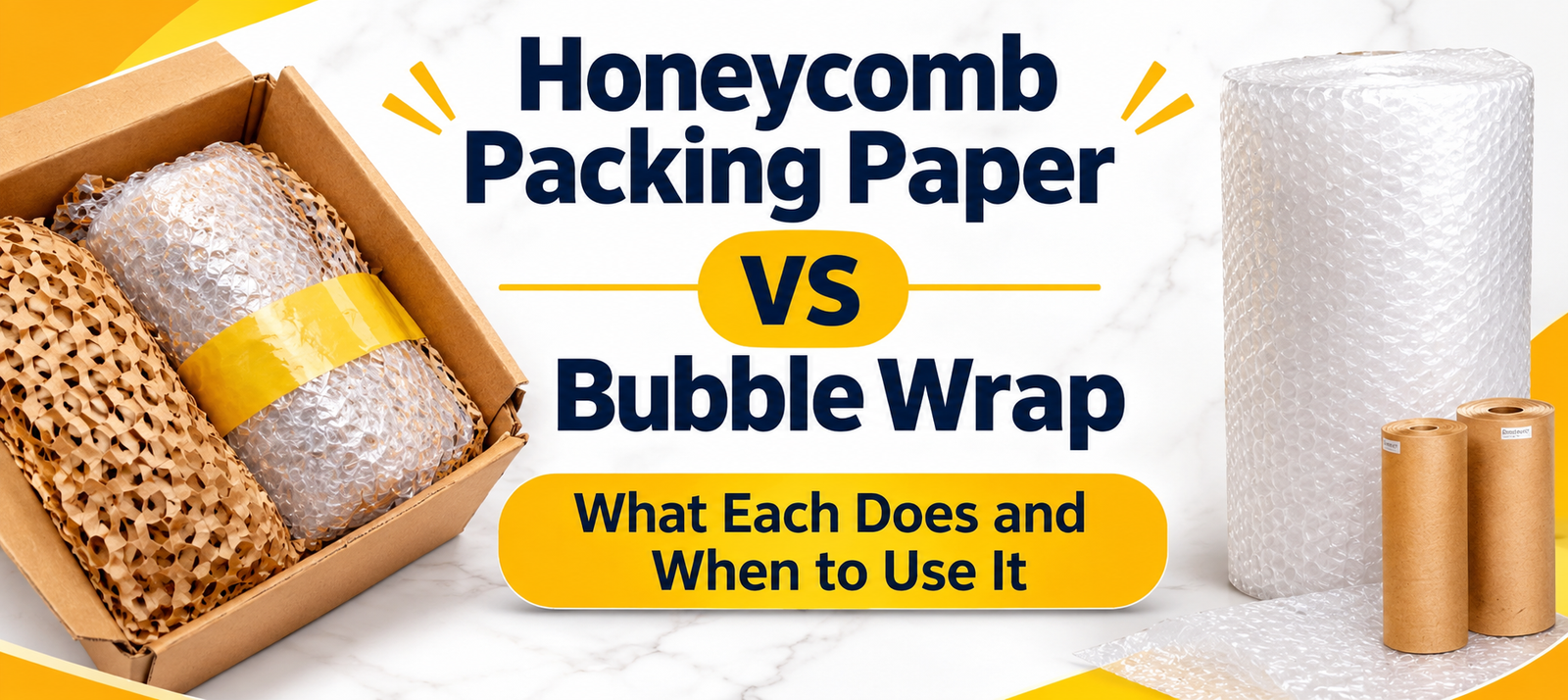
Honeycomb packing paper vs bubble wrap comes down to two ways of cushioning. Honeycomb paper is kraft paper cut with rows of slits and pulled open into a mesh of cells. Bubble wrap is air sealed into pockets of plastic film. This guide found no independent test showing that either one protects better in general. So the choice turns on what you ship, how much room you have to store wrap, and what happens to it after the box is opened.
What Honeycomb Packing Paper Is
Honeycomb wrap starts flat. Patents on expanded slit paper describe a pattern of slits that “produces open cells, preferably of a hexagonal configuration” when the sheet is pulled. One of them, US 5,688,578, was granted in 1997. It puts numbers on the change. The paper grows to 22 times its thickness and about 1.5 times its length. It narrows to about 80% of its width. That is roughly twenty times its volume.
Two details from the patents:
- The second sheet. The 1997 patent pairs the slit sheet with a thin plain separator sheet that “precludes the nesting” of one slit layer into the next. Without it, wrapped layers can sink into each other.
- The paper itself. A later patent, US 10,669,086, says the earlier slit paper was mostly kraft with no stretch. A paper with some stretch, it says, “reduces the tendency of the slit paper to tear during the expanding.”
Not the same as honeycomb paperboard. Honeycomb paperboard is a rigid panel, used as a board rather than a wrap. This guide searched for drop tests on paper honeycomb. Several results, such as this study of paper honeycomb sandwich board, test those panels. They do not tell you how a wrap behaves around a mug.
What Bubble Wrap Is
Wikipedia’s bubble wrap entry dates it to 1957. Alfred Fielding and Marc Chavannes were trying to make a textured plastic wallpaper. It is most often low density polyethylene film “with a shaped side bonded to a flat side to form air bubbles.” Bubbles run from about 6 mm to 26 mm or more, with 1 cm the most common. The entry notes that several layers may be needed for shock and vibration, while a single layer works as surface protection. Antistatic versions exist for electronic parts.
Which Protects Better?
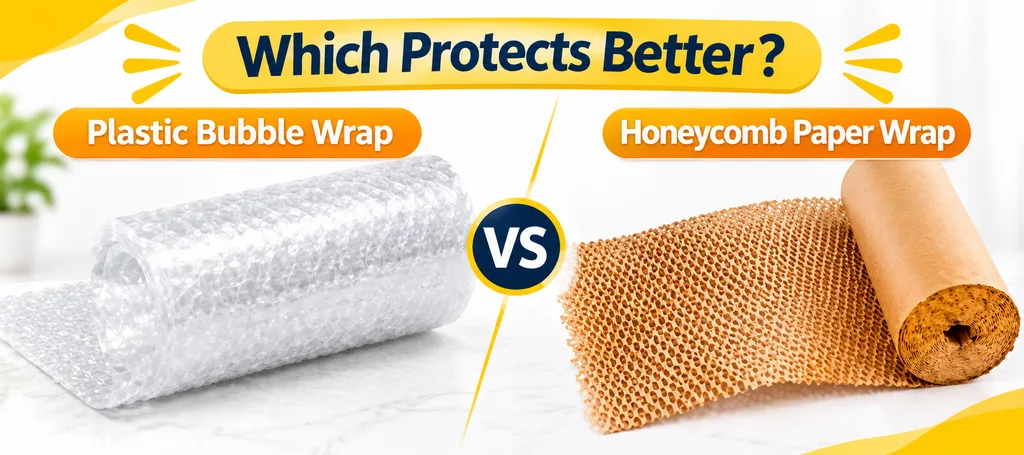
Several of the pages benchmarked for this guide say which one cushions better. This guide did not find an independent test that settles it. One figure turned up in its search: a search result summary credited a 2022 study with finding “22% higher peak force absorption” for honeycomb wrap. The page it pointed to no longer loads, and the study could not be traced.
There is also a reason a single verdict is hard. ASTM D1596 is a standard test method for how cushioning materials absorb a drop. It says its results “are applicable to the cushioning material and not necessarily the same as obtained in a package.” They also change with the “specimen area, thickness, loading rate, and other factors.” So the answer depends on your item’s weight, how many layers you use and the box around it.
What the carrier says is more useful. UPS’s packing page, as of October 2026, says to use bubble wrap “by applying multiple wraps and layers to ensure that the item is completely protected, especially on corners and edges.” It describes crumpled kraft paper as void fill for lightweight items that are not fragile. It does not list expanded honeycomb paper at all. The guide to mailing cookies covers which way the bubbles should face.
So whichever you use for a fragile item, wrap it in several layers and cover the corners and edges. Fill the space around it. Then drop test a packed box before you commit to a material for every order.
Storage and Packing
Honeycomb wrap is stored flat and opened as you pack. The 1997 patent describes it as a product that can be “shipped in the unexpanded form, and expanded at the user’s site.” Standard bubble wrap arrives already full of air. Wikipedia does note a 2015 bubble design that ships flat and is inflated by the retailer, so check what your supplier actually sends.
Recycling and Environmental Claims
The two materials end up in different streams. AF&PA’s 2021 Access to Recycling Study reports that “94% of Americans have access to community paper recycling programs.” Bubble wrap is plastic film. How2Recycle’s store drop off page says plastic bags, wraps and films are not accepted in most US curbside programs. Many can go to store collection bins instead, though not every film qualifies.
That does not make either one a safe environmental claim to print. The source page for this post calls honeycomb paper biodegradable, and another benchmarked page calls it “100% biodegradable and compostable.” The FTC’s Green Guides set conditions for those words. The mylar vs rigid packaging guide covers “biodegradable”, the paper cup guide covers “compostable”, and the box design ideas guide covers “recyclable”.
Honeycomb Paper vs Bubble Wrap Side by Side
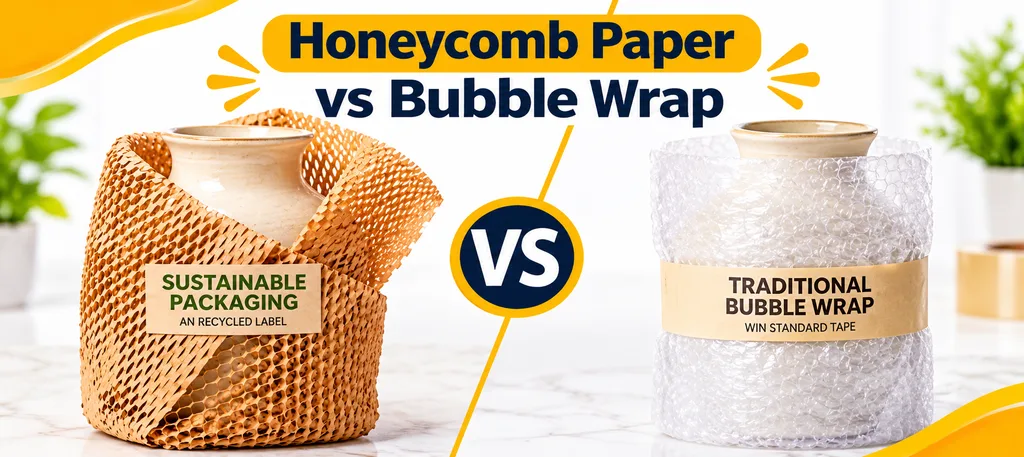
| Honeycomb packing paper | Bubble wrap | |
|---|---|---|
| Material | Kraft paper, slit and pulled open | Polyethylene film with sealed air bubbles |
| How it cushions | A mesh of paper cells | Air in the bubbles |
| Second layer or size | Paired with a separator sheet in the 1997 patent | Bubble size from about 6 to 26 mm |
| Storage | Flat, opened as you pack | Usually arrives inflated |
| UPS packing page | Not listed | Multiple wraps, corners and edges |
| End of life | Paper; 94% access to community paper recycling | Plastic film; not accepted in most curbside programs |
| Moisture | Packaura and Collinbox both warn it weakens when damp | Packaura says sealed air chambers hold up better in damp conditions |
A Third Option: Fitted Inserts
Loose wrap is not the only way to stop an item moving. A fitted insert holds each item in its own cut out. That leaves less to wrap and fill on every order. Custom Boxes Deals makes die cut inserts and dividers, and foam inserts in EPE or EVA where the specification calls for it. Send the item’s size and weight and the insert is cut around it.
Frequently Asked Questions
Is honeycomb paper as good as bubble wrap?
No independent test this guide found settles it in general. ASTM’s cushion test method warns that material results are not the same as results in a package. Whichever you use, wrap fragile items in several layers and drop test a packed box.
Why would honeycomb paper be paired with a plain sheet?
The 1997 patent pairs the slit sheet with a separator sheet that stops one layer nesting into the next.
Can bubble wrap go in the recycling bin?
Usually not at the curb. How2Recycle says films are not accepted in most curbside programs, though many can go to store collection bins.
Is honeycomb packing paper the same as honeycomb board?
No. Honeycomb wrap is slit paper pulled open into a flexible mesh. Honeycomb board is a rigid panel, and drop studies of the board do not describe the wrap.

Anthony Kim
Hello, I'm Anthony Kim, a seasoned packaging consultant and designer. With a professional journey spanning over four years, I've evolved from a budding designer to a recognized expert in the field. Currently holding the position of Packaging Consultant, I've honed my skills in creating not just visually stunning packaging but also solutions that align with strategic business goals.
View all articles →