Request Your Custom Quote
Tell us what you need. Our team normally replies within one business day.
How to Make a Paper Cup: Fold It, Glue It, or See How Factories Do It
 By
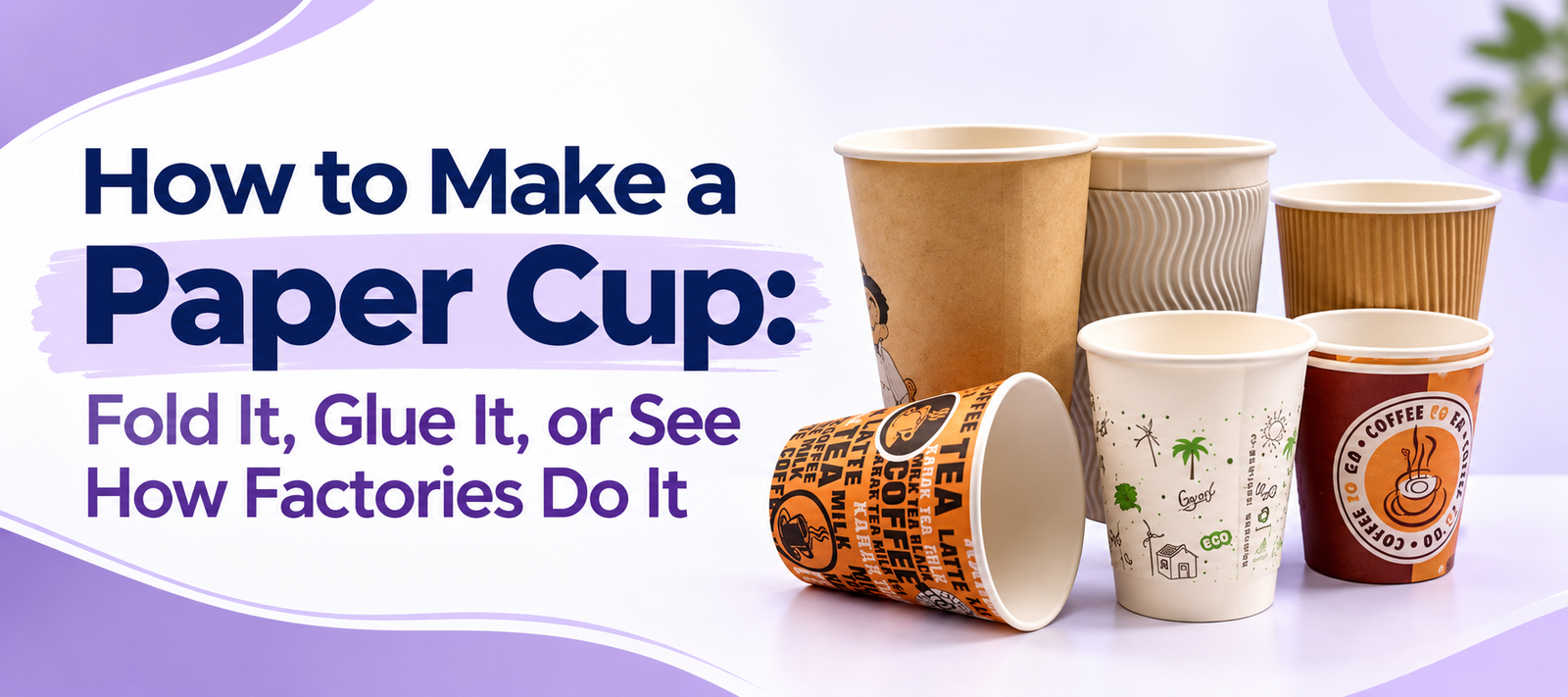
There are three ways to make a paper cup. You can fold one from a square of paper in six steps. You can glue a sturdier one from a curved template and a round base. Or you can see how a cup machine does it, the common factory process that cup patents describe: a printed, fan shaped wall wrapped around a round bottom, heat sealed and finished with a rolled rim. This guide covers all three, then what the lining and wall options do and what can honestly be said about recycling a paper cup.
How to Make a Paper Cup by Folding
You need one square sheet. To square a letter sheet, fold one corner down to the opposite edge and cut off the strip below. These steps follow Jürgen Köller’s annotated paper cup, which also works out the geometry.
- Fold the square in half, corner to corner, into a triangle. Put the long folded edge at the bottom.
- Fold the left corner across to the right edge. Place it so the top edge of the flap is level with the bottom edge.
- Fold the right corner across to the left edge the same way.
- Fold the front top flap down over the front.
- Turn it over and fold the other top flap down.
- Open the pocket between the layers. That is your cup.
For a neater cup, tuck each top flap into the pocket below it instead of folding it flat. Köller notes one limit of the basic fold: “It has no stand.” Hold it, or rest it in something.
What size cup does a square make? Köller works it out. Flattened, the cup is a trapezoid. Its height is about 0.41 times the side of the square, its top about 0.59 times, and its bottom about 0.24 times. We checked those values by computing the folds again.
| Square | Height | Top, flat | Bottom, flat |
|---|---|---|---|
| 6 in | 2.5 in | 3.5 in | 1.5 in |
| 7 in | 2.9 in | 4.1 in | 1.7 in |
| 8.5 in | 3.5 in | 5.0 in | 2.1 in |
Can you drink from it? Köller’s answer is conditional: “If the paper is not printed inside and sturdy, you can even drink from it.” Plain paper has no waterproof lining, which is the job a factory cup’s coating does. One page benchmarked for this post suggests coating the inside with clear nail polish. No source read for this guide supports any home coating as fit for drinks, so treat a folded cup as quick and short lived.
How to Make a Paper Cup With Glue That Stands
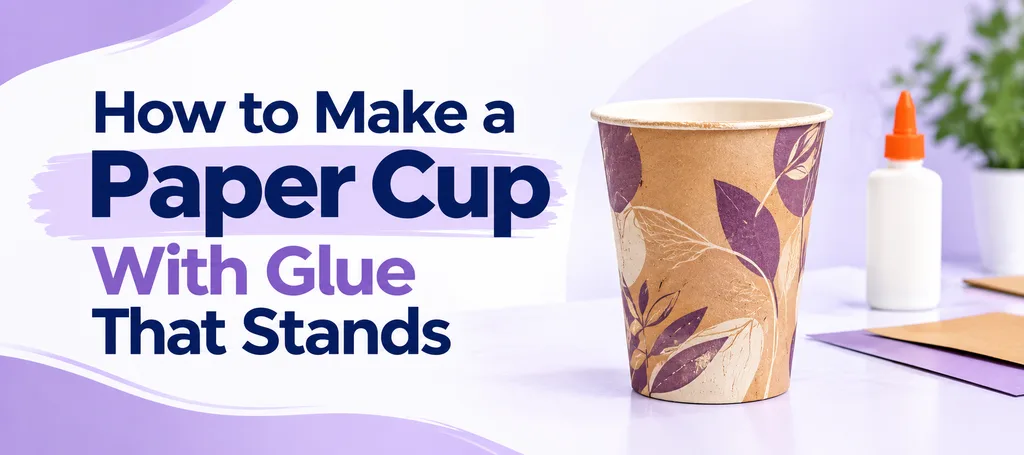
A cup’s wall is the side of a cone with its tip cut off. Flattened, it is a curved band, the same fan shape a factory cuts. You can draw one to any size with a compass, or a pencil on a string, and a protractor.
Pick three sizes: the top width, the bottom width and the height. Then work out four numbers.
- Slant height. Take half the difference between the two widths. Square it, add the square of the height, and take the square root.
- Outer radius. Multiply the slant height by the top width, then divide by the difference between the two widths.
- Inner radius. The outer radius minus the slant height.
- Angle. 360 degrees times the difference between the two widths, divided by twice the slant height.
Here is a worked example, checked by calculation:
| Cup | Slant height | Outer radius | Inner radius | Angle | Fits on |
|---|---|---|---|---|---|
| 3 in top, 2 in bottom, 3 in tall | 3.04 in | 9.12 in | 6.08 in | 59.2° | Letter paper turned sideways, about 9 by 3.8 in |
To make it:
- From one center point, draw two arcs at the outer and inner radius.
- Mark the angle with a protractor and draw two straight lines from the center to close the band.
- Add a narrow glue tab along one straight edge, then cut out the band.
- Roll the band into a cone and glue the tab inside the other edge.
- Cut a circle the width of the cup’s bottom, with a lip around it. Snip the lip into tabs and fold them down.
- Push the circle up inside the cup from below and glue the tabs to the wall.
Card stock holds its shape better than printer paper. A glued craft cup is good for dry snacks, pencils or a size test. It is not a drinking cup, for the same reason as the folded one: nothing waterproofs it.
How Paper Cups Are Made in a Factory
Factory cups follow the same idea as the glued cup. In the patents read here, the machine seals with heat instead of glue. Patents for cup machines and cups describe the sequence. The steps below come from US 9,371,149 and two patents from Paper Machinery Corporation, a Milwaukee maker of cup machines: US 5,556,364 and US 7,311,243.
- Coated paper. The cup stock is paperboard with a plastic coating, polyethylene in two of the patents and polypropylene as the example in a third. The coating lets parts be sealed together by heat.
- Printing. The cup’s design is printed on the wall stock.
- Die cutting. The printed stock is cut into fan shaped sheets for the walls.
- The bottom. A round bottom is cut and held on the end of a mandrel by vacuum. Its edge is folded down into a lip.
- The side seam. The wall sheet is wrapped around the mandrel, heated and sealed along an overlapped seam that runs up the side.
- The bottom seal. In some designs, the wall’s lower edge is curled in over the bottom’s lip and pressed from inside. That seals the base and gives the cup a recessed bottom.
- The rim. The top edge is rolled outward. The 1996 patent says the curl gives “a more functional drinking container and a better appearance.”
In these machines the mandrels sit on a turret, which turns each cup from one station to the next.
The 2007 patent names the hardest part. “The overlapped side seam is the most difficult area of the rim on a paper cup to form, because of the double layer of paper.” A badly formed seam splits and bulges at the rim, which the patent calls “flagging”. It “affects the appearance and lid fit of the cup.” If you are approving sample cups, check the lid where it crosses the seam.
Paper Cup Materials, Linings and the Recycled Paper Question
Wikipedia’s paper cup entry calls the base paper “cup board” and says it “has a barrier coating for waterproofing.” It gives cup board weights of 170 to 350 g/m², citing a 1998 papermaking textbook. The lining keeps the drink in and, as the patents describe, lets the seams be heat sealed. The insulated cup patents read for this guide put insulation in an outer wall or an air gap, not in the lining.
The source page for this post says cups use “new paper and not a recycled one. This is a rule for food safety.” FDA’s section on pulp from reclaimed fiber reads differently. 21 CFR 176.260 says “pulp from reclaimed fiber may be safely used” in articles for packaging or holding food. It excludes paper carrying a poisonous or deleterious substance that would migrate to food, and paper used to ship one. So recycled fiber is not banned outright by that section. Whether a given cup board uses new or recycled fiber is a question to ask the mill or the cup maker.
Single Wall, Double Wall and Ripple Wall Paper Cups
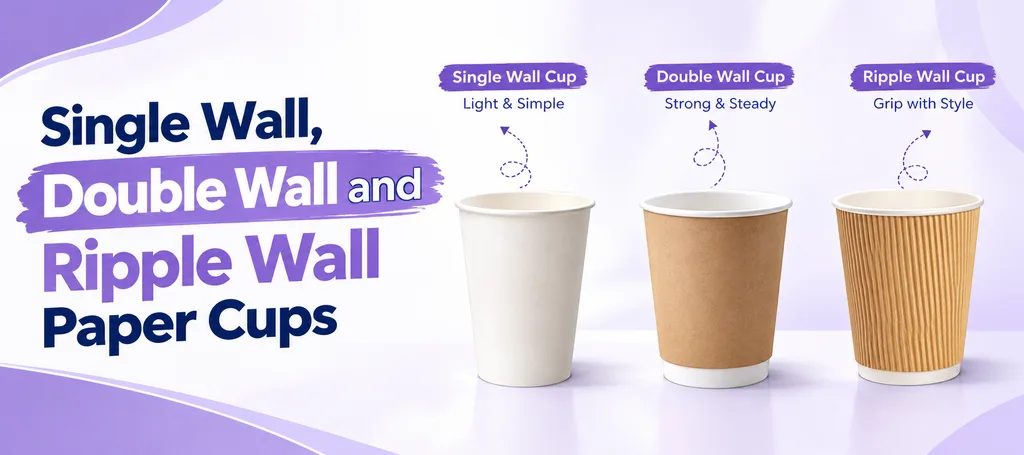
- Single wall. One layer of cup board, the cup described above.
- Double wall. A second paper wall wrapped around the inner cup. A patent from Unicup, EP 2583913, describes an earlier design with an outer sleeve “kept at a certain distance” from the inner wall, leaving an air gap.
- Ripple wall. A fluted outer layer. The same Unicup patent covers an insulating cover formed with creases whose bottoms touch the inner cup. A Seda patent, US 8,146,797, wraps the cup in corrugated material glued at its ends.
These patents describe the outer layer as insulation. How warm or cold a given cup keeps a drink depends on its build, and no figure is given here.
Can You Recycle a Paper Cup?
It depends on where you live. In May 2026 the Foodservice Packaging Institute reported that 20% of the US population lives where both hot drink and cold drink paper cups are accepted for recycling. A 2015 to 2016 study had estimated that 5% had access to residential programs that accepted paper cups. FPI says the plastic lining “was seen as a barrier to recycling”, and that mills can now separate it and recover the fiber.
So whether a paper cup can be recycled depends on the local program. On FPI’s figures, most Americans do not yet live where both kinds are accepted. Whether a cup can carry a “recyclable” message is an FTC Green Guides question. The box design ideas guide covers when that claim works.
Cups sold as compostable fall under a separate section of the FTC’s Green Guides. The FTC asked for public comment on the Guides in December 2022, and as of October 2026 the Federal Register shows no revised version. 16 CFR 260.7 asks for evidence that “all the materials in the item will break down into, or otherwise become part of, usable compost” in a safe and timely way. If the item cannot be composted at home, the claim should say so. If composting facilities are not available to “a substantial majority of consumers or communities where the item is sold,” the claim should say that too. So a cup sold as compostable needs evidence for every material in it, lining included, and those qualifiers where they apply.
A Short History of the Paper Cup
Paper cups are old. Wikipedia, citing Joseph Needham’s history of Chinese science, records paper cups called chih pei used for serving tea in imperial China.
The modern disposable cup’s US story starts in Boston. Lafayette College’s history of the Dixie Cup Company traces it to Lawrence Luellen in Boston. He became interested in an individual drinking cup in 1907, when shared dippers and glasses were a health worry. He first conceived a one piece pleated cup, “treated with paraffine to hold the folds in place.” In early 1908 he worked on a two piece cup: a paper blank rolled into a cone with its tip cut off, with a separate bottom piece. His company made only that one, because it cost much less to make. It is the same two piece build the cup patents above describe.
Lafayette biology professor Alvin Davison published “Death in School Drinking Cups” in August 1908. In 1909 Kansas passed the first state law against the common drinking cup. By 1912 the product was called the Health Kup. In 1919 it became the Dixie Cup, named for a line of dolls.
Ordering Custom Printed Paper Cups
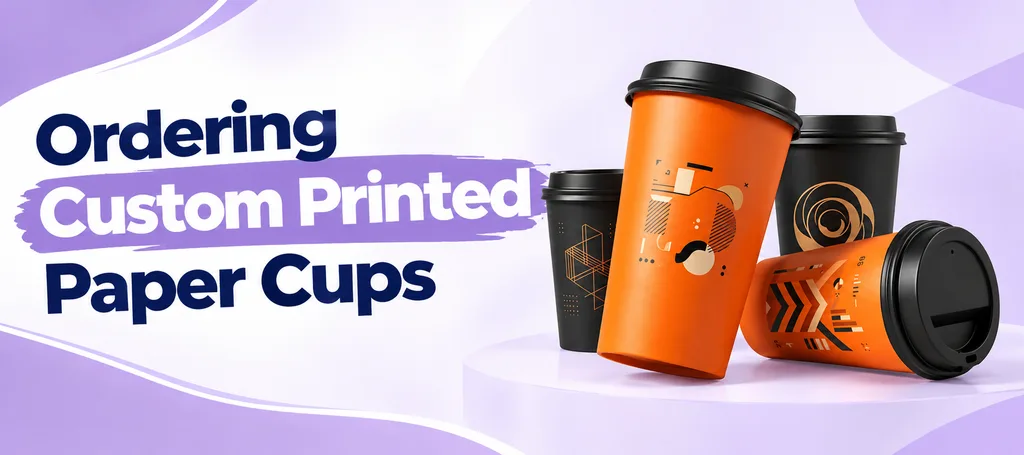
If you need cups with your brand on them, the folding and gluing above will not get you far. Custom Boxes Deals makes them to order. Paper cups are made in custom sizes, in single wall, double wall and ripple wall, with PE, PLA, aqueous or PP linings and matching lids.
Hot or cold use, how well a cup holds heat, and leak resistance all depend on the specification you choose, so they are confirmed at quote rather than promised here. Tell us what goes inside and we will confirm which materials suit it at quote. If you already have cups and want to brand them, printed cup sleeves are another route, and the custom sleeves range has more.
Frequently Asked Questions
How do you make a paper cup by folding?
Fold a square into a triangle, fold each side corner across to the opposite edge, fold the two top flaps down, one on each side, and open the pocket. The full steps are above.
How big a cup does a sheet of paper make?
A folded cup is about 0.41 times as tall as the side of the square. A 7 inch square gives a cup about 2.9 inches tall.
Can you drink from a paper cup you folded?
Köller says you can if the paper is sturdy and not printed inside. Unlike a factory cup, it has no waterproof lining.
Why are paper cups lined?
To keep liquid from soaking the board. In the patents read here, a plastic coating also lets the machine heat seal the side seam and the bottom.
Are paper cups recyclable?
In some places. FPI reported in May 2026 that 20% of the US population lives where both hot and cold drink paper cups are accepted for recycling. Check your local program.

Anthony Kim
Hello, I'm Anthony Kim, a seasoned packaging consultant and designer. With a professional journey spanning over four years, I've evolved from a budding designer to a recognized expert in the field. Currently holding the position of Packaging Consultant, I've honed my skills in creating not just visually stunning packaging but also solutions that align with strategic business goals.
View all articles →