Request Your Custom Quote
Tell us what you need. Our team normally replies within one business day.
Greeting Card Dimensions: US Sizes and the ISO Mix Up
 By
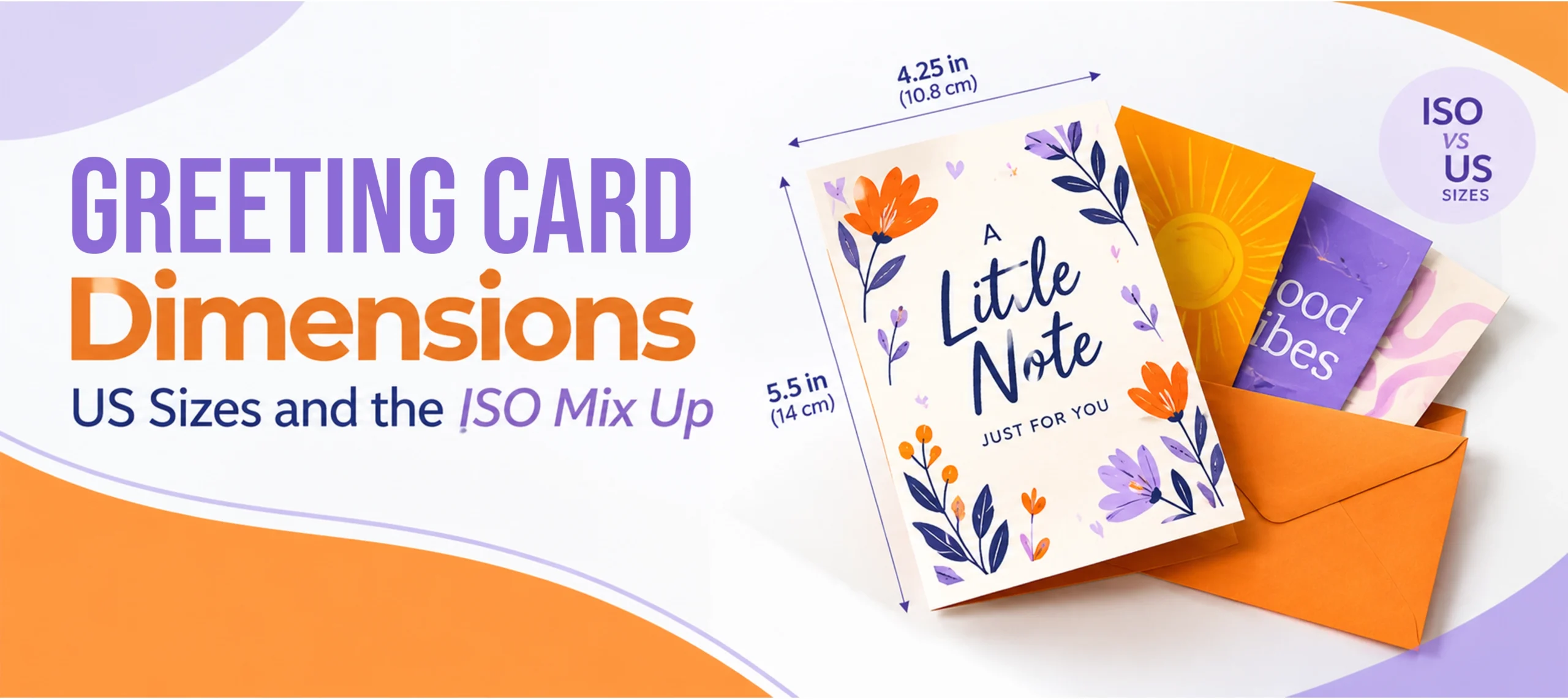
By A standard US greeting card runs A2, A6, A7 or A9, and the most common single size is A7, 5 by 7 inches. Those same letters and numbers also name a completely different, metric paper size used almost everywhere outside North America, and mixing the two up is the single easiest way to order the wrong card. This guide gives you the real US sizes, the matching envelope dimensions, and a mailing cost trap tied directly to shape rather than size.
What Are the Standard US Greeting Card Sizes?
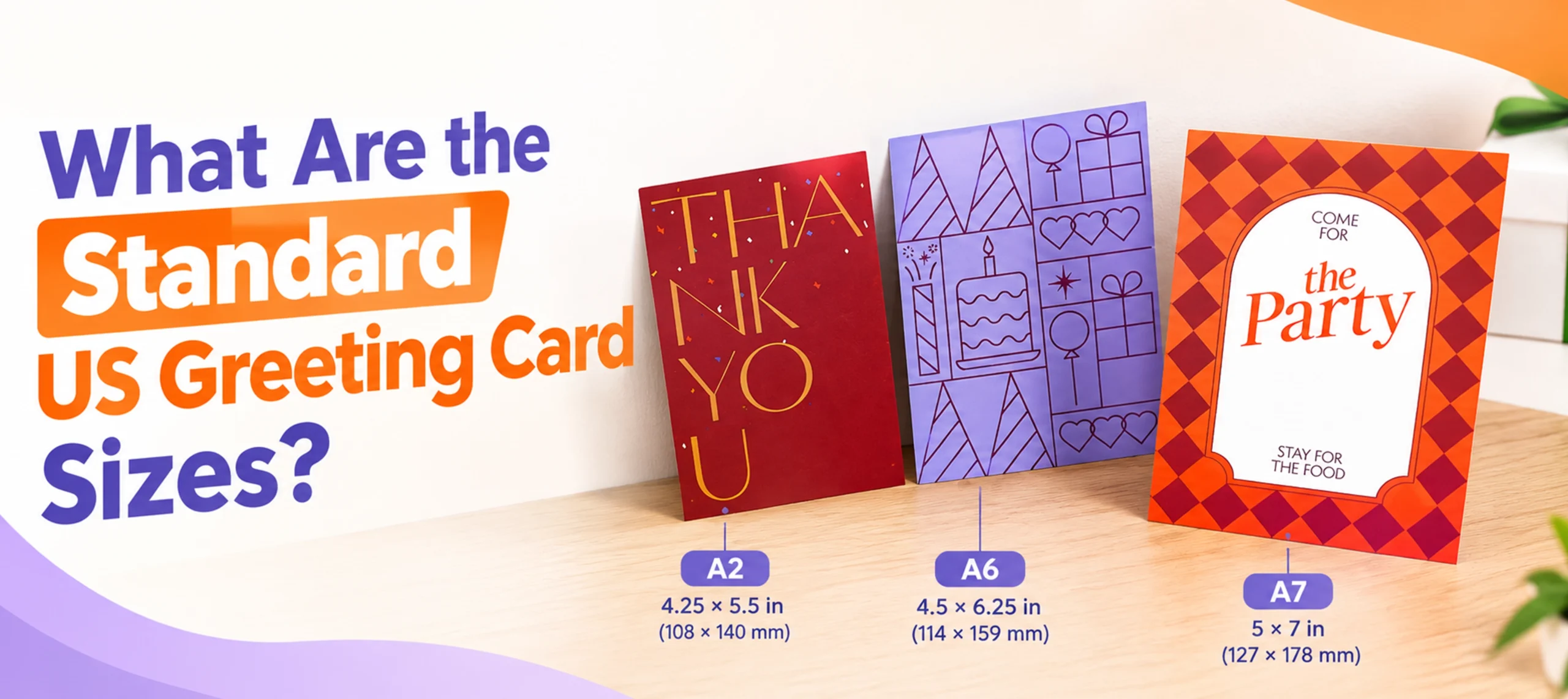
Four codes cover most of what ships in the United States.
A2 measures 4.25 by 5.5 inches, a compact size common on note cards and RSVP cards. A6 measures 4.5 by 6.25 inches. A7 measures 5 by 7 inches, the most widely used size for standard greeting cards and invitations. A9 measures 5.5 by 8.5 inches, used for larger invitations and cards with more to say.
Square cards, commonly 5 by 5 or 6 by 6 inches, and slimline cards, narrow formats around 4 by 9 inches, cover most of what falls outside the four main codes.
Are US Card Sizes the Same as ISO A6 and A7?
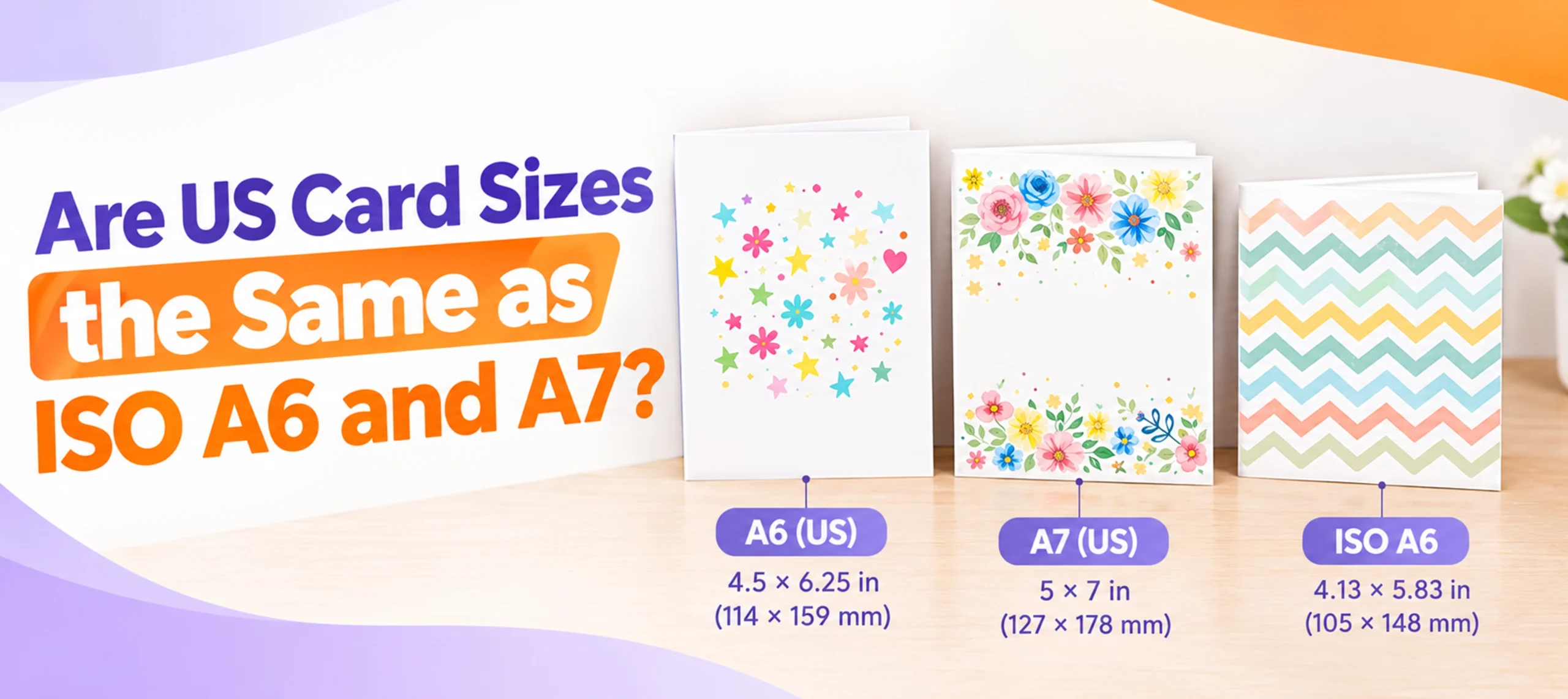
No, and this is worth being direct about, because getting it wrong is an easy mistake to make.
The US stationery trade reused the letter A and a number from a completely different standard, the ISO 216 international paper series, used across Europe and most of the world. Wikipedia’s ISO 216 entry lists the real ISO A6 as 105 by 148 millimeters, about 4.1 by 5.8 inches, and ISO A7 as 74 by 105 millimeters, about 2.9 by 4.1 inches. Compare that to the US A6 above, 4.5 by 6.25 inches, and US A7, 5 by 7 inches. Both pairs share a name and share nothing else.
This is not a hypothetical mix up. Searching for greeting card sizes turns up guides that state a US A6 card is 4.5 by 6.25 inches while treating that figure as if it were also the international A6, with no note that the two numbers describe different sized objects. If you are ordering from a US printer, the four codes above are the ones that apply. If a supplier or a spec sheet is working from ISO paper sizes instead, ask directly rather than assuming the two systems match.
What Size Envelope Fits Each Card?
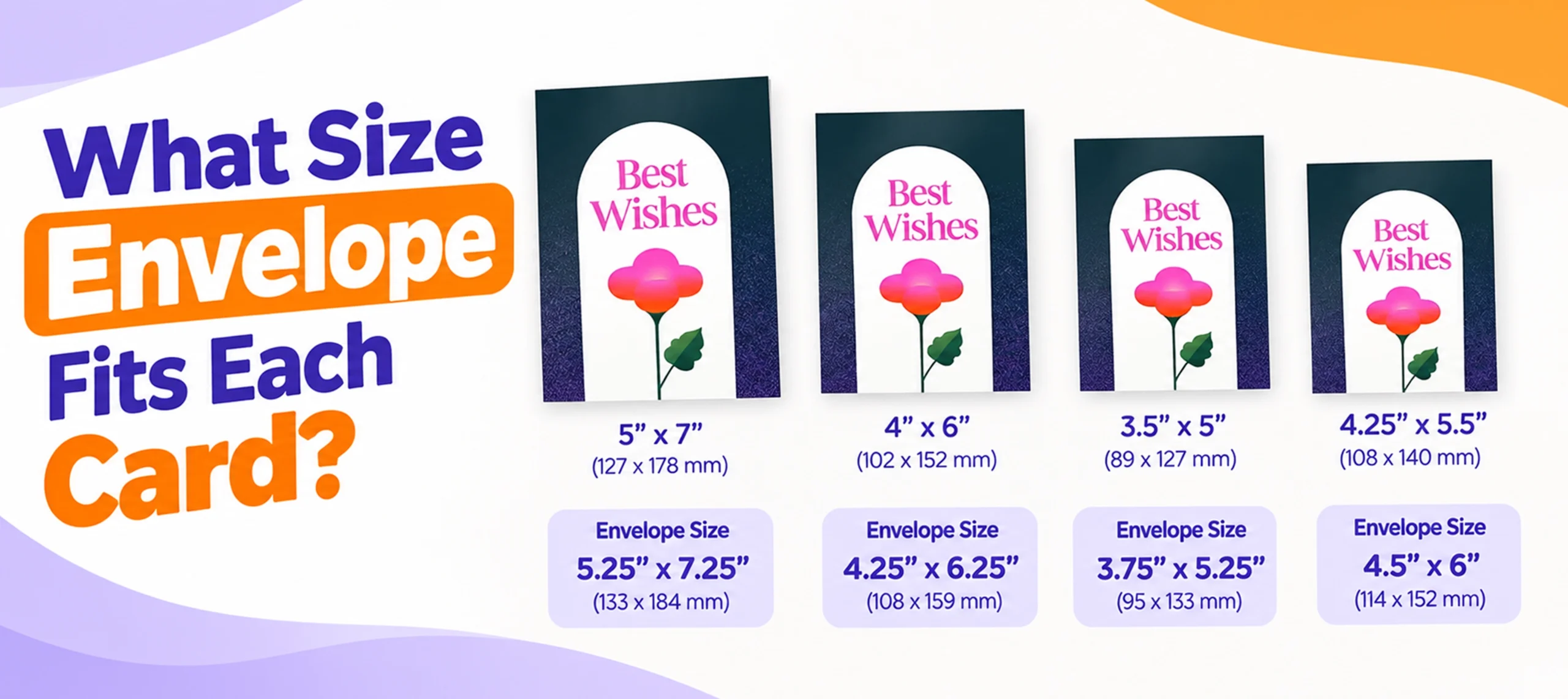
Each US card code pairs with a matching envelope, generally with a small amount of extra room so the card slides in and out without resistance.
An A2 card pairs with an A2 envelope. An A6 card pairs with an A6 envelope. An A7 card, the most common size, typically pairs with an A7 envelope, sometimes listed as 5.25 by 7.25 inches. A9 cards need the roomier A9 envelope. The full range of standard and specialty envelope dimensions, including these and several more, is covered in detail in our own envelope size guide, which this post does not repeat.
Does a Square Greeting Card Cost More to Mail?
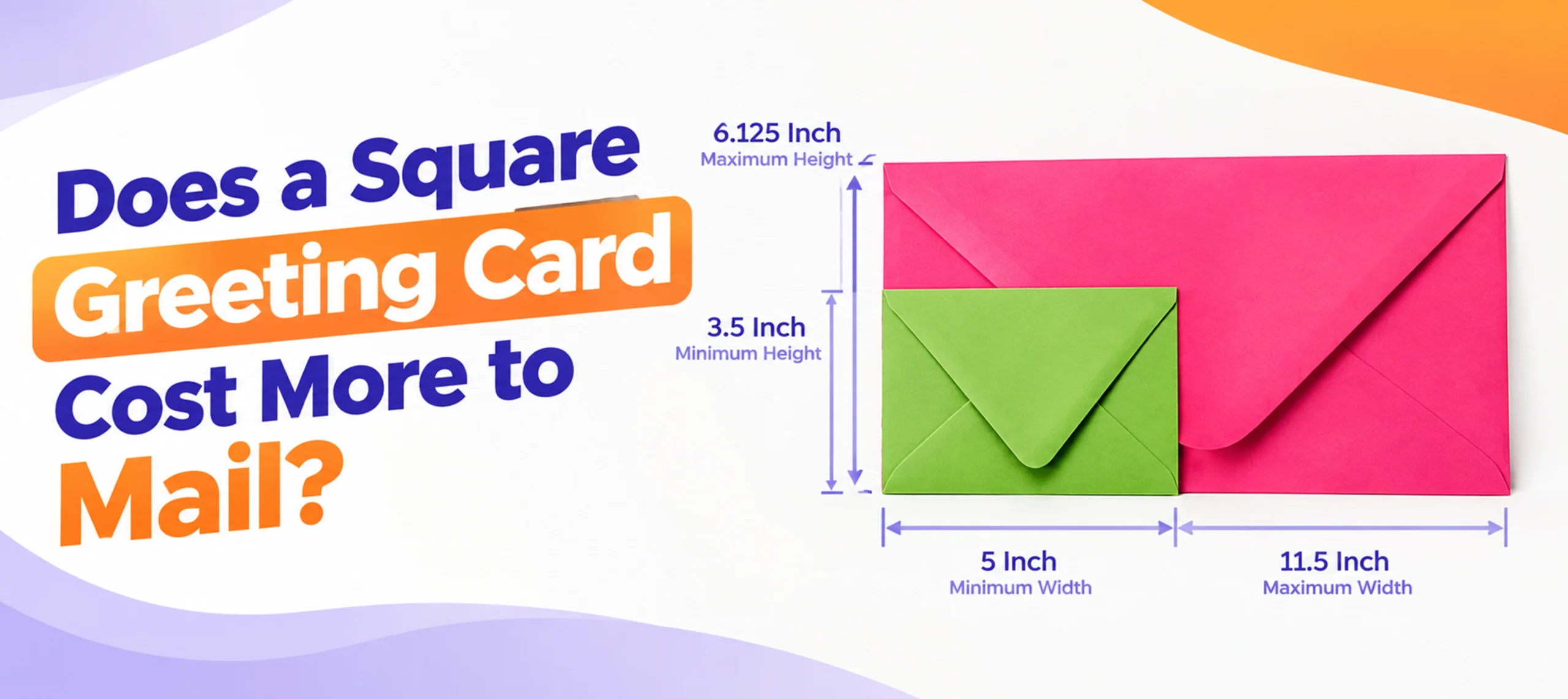
Often, yes, and the reason is shape rather than size.
The United States Postal Service names a square greeting card directly as an example of mail that draws an extra charge. USPS’s own Postal Explorer states plainly that “customers can be unpleasantly surprised that they must pay extra postage when, for example, they mail a square greeting card,” because rigid, square, or unusually shaped pieces are harder for postal equipment to process and get sorted by hand instead.
That surcharge applies on top of standard postage, and the exact amount changes with USPS rate updates, so it is worth checking current First Class Mail rates directly before mailing a large batch of square cards rather than assuming the sticker price on a stamp covers it.
How Do You Choose the Right Card Size?
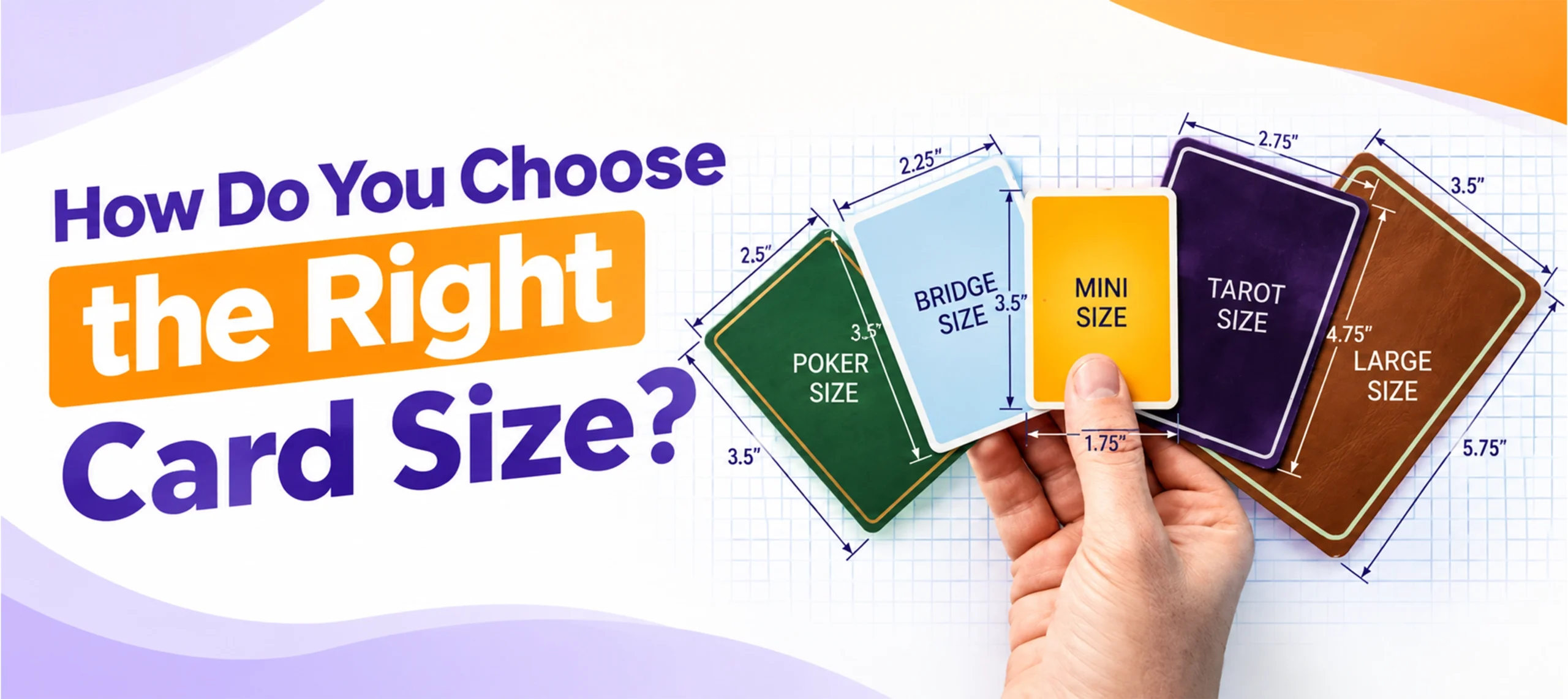
The occasion usually decides the size before the shape does.
A2 and A6 suit short notes, thank you cards and RSVPs, where a compact card feels right and keeps postage predictable. A7 is the safe default for birthday, holiday and general greeting cards, since it is both the most common size and, being rectangular rather than square, avoids the mailing surcharge above. A9 suits formal invitations or anything with more text or a larger design that needs the room. Square cards look distinctive on a shelf or in a gift set, which is worth the mailing cost tradeoff for some brands and not for others.
How Do You Get Custom Card Sizes and Boxes?
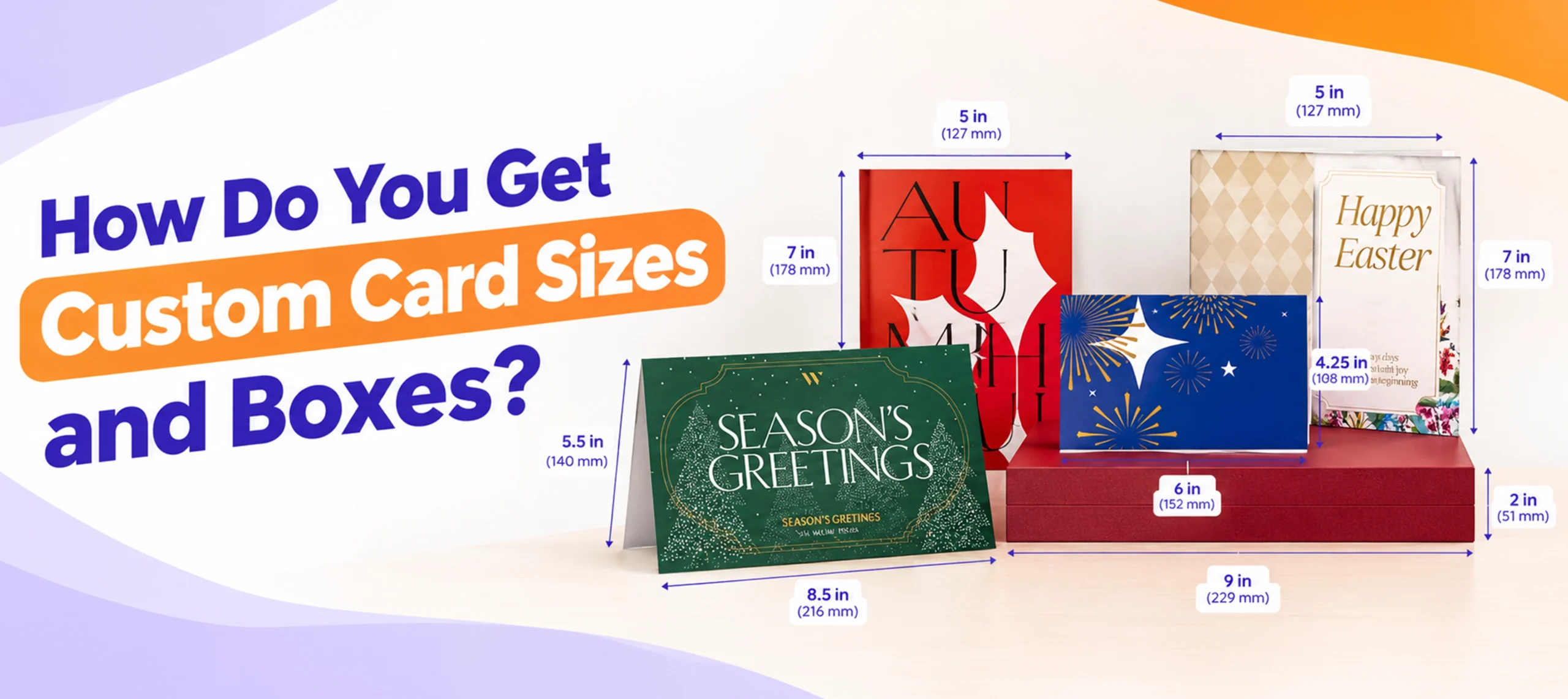
Once the size question is settled, printing and presentation are the next decision.
At Custom Boxes Deals we manufacture directly, not through third parties, and design support is free with no design fees. A free 3D mockup comes before production approval. Materials include kraft, corrugated, rigid board, SBS and cardstock, and we print CMYK, Pantone or PMS, or leave stock unprinted. Our minimum order is 100 units per design.
Custom Christmas cards cover printed cards built to a specific size and message. For a set that needs to look finished as a gift rather than mailed individually, boxed Christmas cards pair the cards with a printed box and matching envelopes in one order.
If a card is only part of what you are packaging and the box itself is the real question, our box style guide is the place to start instead.
Frequently Asked Questions
What are the standard greeting card dimensions?
A7, 5 by 7 inches, is the most common US greeting card size. A2, A6 and A9 are the other standard codes, running smaller to larger around that middle size.
Is a US A6 card the same size as ISO A6 paper?
No. US A6 is 4.5 by 6.25 inches. ISO A6, the international metric standard, is 105 by 148 millimeters, about 4.1 by 5.8 inches. They share a name and are genuinely different sizes.
Does mailing a square greeting card cost more?
Often, yes. USPS names square envelopes directly as an example of mail that draws a nonmachinable surcharge, because square and rigid shapes are harder for sorting equipment to process.
What envelope size fits an A7 card?
An A7 envelope, commonly listed around 5.25 by 7.25 inches, gives an A7 card room to slide in and out without resistance.
What size card should I use for a business thank you note?
A2 or A6 work well for a short thank you note, both compact enough to keep postage predictable and sized to a brief message rather than a long one.
Can I get a custom size greeting card printed?
Yes. A card built to your own dimensions, rather than adjusted from one of the standard codes, is available alongside standard sizing.

Anthony Kim
Hello, I'm Anthony Kim, a seasoned packaging consultant and designer. With a professional journey spanning over four years, I've evolved from a budding designer to a recognized expert in the field. Currently holding the position of Packaging Consultant, I've honed my skills in creating not just visually stunning packaging but also solutions that align with strategic business goals.
View all articles →