Request Your Custom Quote
Tell us what you need. Our team normally replies within one business day.
Rigid Box Inserts: How to Choose EVA, EPE, Paperboard, Pulp or Satin
 By
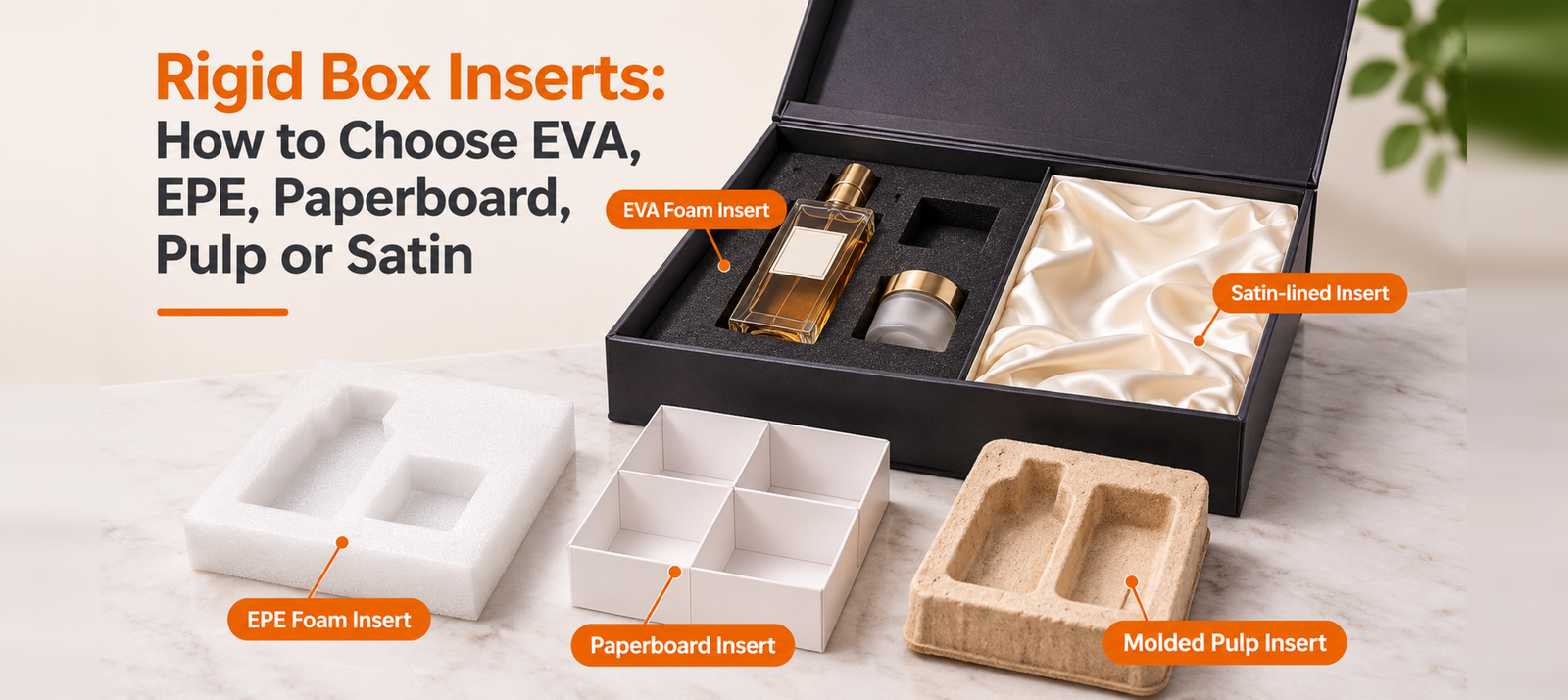
Rigid box inserts are chosen from the product, not from a list of materials. Start with four facts about what goes in the box: how heavy it is, how easily its surface marks, how many pieces travel together, and whether the box is handed over or shipped. Then pick the material. EVA and polyethylene foam hold a piece in a cavity cut to its shape. Paperboard holds it in a die cut frame and can carry print. Molded pulp cradles it in a formed fiber tray. Satin is a lining, and any padding under it is a separate choice. Custom Boxes Deals makes custom rigid boxes with EVA and EPE foam inserts, die cut inserts and satin linings.
Which Insert Suits Which Product
| Product | What the insert has to do | Materials that fit | Settle on the quote |
|---|---|---|---|
| Ring, earrings or a pendant | Hold a small piece in place and show it when the lid opens | A foam slot or cavity; a satin lined interior | Slot or cavity size per piece, lining color |
| Necklace or bracelet | Keep the chain laid out so it does not tangle or slide | A foam or board pad with a cut channel; a satin lined interior | How the chain is held, pad color |
| Fragrance bottle | Hold a glass bottle and its cap still, upright or lying down | A foam cavity cut to the bottle; a paperboard frame | The bottle and cap measured as filled, which way it lies |
| Device with accessories | Give the device, cable and charger each a place | Foam with one cavity per piece, in one or two layers | The layout, and how each piece is lifted out |
| Skincare or gift set | Give every piece its own place and the set a fixed order | A paperboard frame, foam, or molded pulp | Piece count, which piece is seen first |
| Candle jar or heavy glass | Carry the weight without the piece settling into the base | Foam with enough depth under the piece, or molded pulp | The filled weight, and whether the box travels inside a carton |
| A printed message inside | Carry print where the customer looks first | Paperboard | What is printed on the insert itself |
Foam holds each piece in its own position, which matters more the more pieces travel together. For a single light piece that is handed over in person, a lined interior with a simple pad may be all the box needs. For jewelry and fragrance, our custom jewelry boxes and custom perfume boxes are made to the piece.
The Foams, From the Makers’ Own Data
EVA foam is ethylene vinyl acetate. The foam maker Zotefoams describes its Evazote range as closed cell, crosslinked ethylene copolymer foam with densities from 30 to 50 kg/m³, and Algeos, a distributor of it, sells it as ethylene vinyl acetate copolymer foam. Zotefoams says Evazote is tougher than its own crosslinked polyethylene foam because it is more resilient. Wikipedia lists EVA foam in play mats and padding for sports equipment.
Polyethylene foam is sold under two names on insert quotes. EPE, expanded polyethylene, is described by Wikipedia’s article on expanded polyethylene as a low density, semi rigid, closed cell foam, typically 29 to 120 kg/m³, with the lower figure the common one. XPE is crosslinked polyethylene. Zotefoams’ Plastazote is one: crosslinked low density polyethylene foam, sold from 15 to 115 kg/m³.
The two names overlap. Wikipedia says EPE beads can be crosslinked or not, depending on the process. It also cites an estimate that most polyethylene foam used in 2001 was non crosslinked, with crosslinked foam about a third. So when a quote says “EPE,” ask whether the foam is crosslinked.
Polyurethane foam works differently. The Polyurethane Foam Association describes flexible polyurethane foam as open cell, used in furniture, cars and packaging among other things. EVA and both polyethylene foams above are closed cell. Wikipedia places EPE between expanded polystyrene and polyurethane in stiffness.
Why Foam Density Charts Disagree
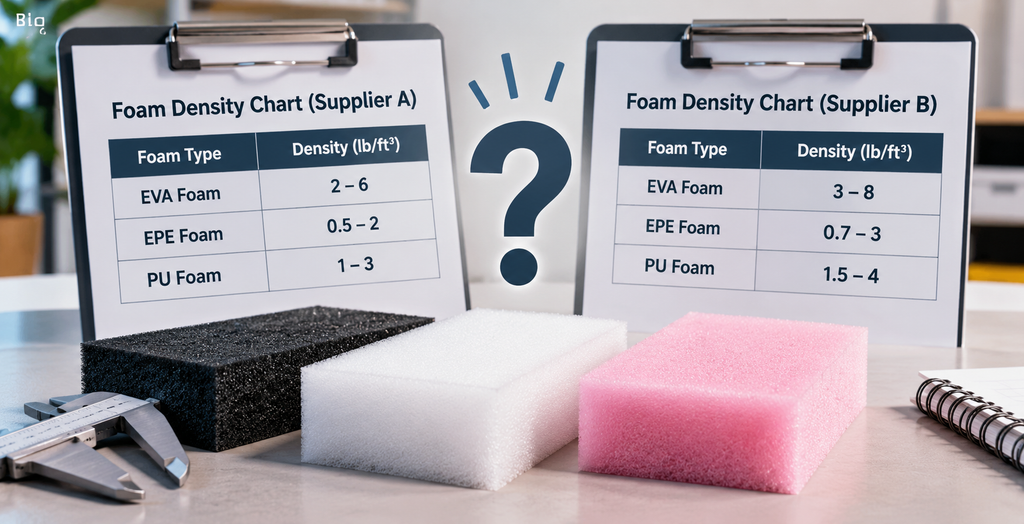
The supplier pages read for this post each give one density range per foam, and they do not agree with each other or with the maker. Here are the three that state a range, beside Zotefoams’ own figures and Wikipedia’s.
| Source | EVA foam | Polyethylene foam | Polyurethane foam |
|---|---|---|---|
| Supplier guide A | 25 to 45 kg/m³ | 18 to 33 kg/m³ | 40 to 80 kg/m³ |
| Supplier product page B | 33 to 280 kg/m³ | 20 to 120 kg/m³ (EPE) | 18 to 45 kg/m³ |
| Supplier guide C | 2 to 8 lb/ft³ (about 32 to 128 kg/m³) | 30 to 300 kg/m³ (XPE) | Not given |
| Zotefoams, maker | 30 to 50 kg/m³ (Evazote) | 15 to 115 kg/m³ (Plastazote, crosslinked) | Not made |
| Wikipedia | Not given | 29 to 120 kg/m³ typical (EPE) | Not given |
Two of the guides read for this post rank the foams by density: EVA as the high density foam, crosslinked polyethylene as the low one. One maker’s own ranges do not fit that order. Zotefoams’ crosslinked polyethylene foam goes up to 115 kg/m³, more than twice the 50 kg/m³ top of its EVA range.
Density is a grade you pick, not a property of the material. In November 2026 Zotefoams listed 29 Plastazote and 4 Evazote product sheets, and it says its product sheets cover densities, cell size, strength and resilience. Density is one figure among several on those sheets.
What to do with that: ask for the foam’s grade name and its density in kg/m³ or lb/ft³ on the quote, and keep it with your order. Then a repeat order can be matched to the same foam, not to a word like “high density.” One lb/ft³ is about 16.02 kg/m³, computed from the exact pound (0.45359237 kg) and foot (0.3048 m).
Paperboard Inserts
A paperboard insert is cut and folded from flat board, so it can hold a product in a frame, a slot or a raised platform. It takes print like the box does, which makes it the material for a message, a care card or a product name sitting right where the customer looks.
A foam cavity cut to the shape touches the piece all the way round, while a board frame holds it at its edges. For a heavy piece or one with an odd shape, that difference is worth seeing in a sample. A set can combine the two: a printed board frame on top, foam where each piece sits.
Molded Pulp Inserts
Molded pulp is formed from wet fiber on a mold. Wikipedia’s molded pulp article says it is typically made from recycled paperboard or newsprint, and describes three kinds that look quite different:
- Thick wall, about 1.5 to 6 mm, rough on one side and moderately smooth on the other, used for heavy item and edge protection.
- Transfer molded, thin walled, about 1/16 to 3/16 inch, the most common kind, used for electronics, egg cartons and drink trays.
- Thermoformed fiber, pressed in heated molds, smooth and accurately formed, with the appearance of a plastic tray.
For a premium box, the kind matters more than the material name. Ask which kind is being quoted and see a sample. Because each part is formed on a mold made in its shape, a new insert shape means a new mold.
Satin and Fabric Linings
A satin lined box has a satin interior. The satin changes the surface the product sits on and what the customer sees when the lid opens. Whether there is padding under the satin, and how much, is a separate part of the specification, so ask for it by name. Satin pairs well with a ring slot, a watch pillow or a necklace pad, where the lining is the backdrop and the cut shape does the holding.
Details to Settle Before the Insert Is Cut
- Measure the finished product. Measure it filled, capped and closed, the way it will sit in the box, and say whether the size varies from batch to batch.
- Cavity depth. Decide how far the product sits into the insert, and how a customer gets it out. A finger notch or a ribbon pull are worth asking about for anything that sits deep.
- The lid side. Say whether anything should press on the product from above when the lid closes.
- Layers. One level, or a lift out tray with a second layer underneath.
- Color. Foam and lining colors change how the product reads. A black insert and a white one look very different under a pale product.
- Grade and density. Write the foam grade and its density on the quote, as above.
Our post on the benefits of rigid boxes explains how a rigid box should travel by parcel, and why UPS’s packaging guidelines ask for a second box around luxury goods.
When the Box Is Thrown Away
An insert is often a different material from the box around it. A foam insert inside a paper wrapped board box means the customer has two things to sort, not one. A paperboard insert is the same family of material as the box. Wikipedia describes molded pulp as often considered a sustainable packaging material that can be recycled again after use.
The FTC Green Guides set out what a brand can honestly print about recycling a rigid box, and that same post on rigid box benefits walks through them. Make the insert choice before the recycling wording, not after.
Rigid Boxes With Inserts at Custom Boxes Deals

Custom Boxes Deals makes rigid boxes with foam inserts, with EVA foam inserts and EPE foam inserts to the specification chosen for each order. We also make custom die cut inserts and satin lined boxes, and the full range sits under custom insert boxes.
The box is cut to your product’s dimensions, so movement inside it is controlled. An insert holds the product in one position rather than letting it shift in transit. Foam grade, density and color, and satin color and padding, are confirmed per order. You see a free 3D mockup before production approval, and a real product video of the packaging before bulk production begins. Our minimum order is 100 boxes.
For any other insert material, ask before you plan around it.
Frequently Asked Questions
What is the best insert for a rigid box?
There is no single best one. Match it to the product: foam where each piece needs its own cavity, paperboard where the insert carries print, molded pulp where a formed fiber tray suits the look, and a satin lining where the surface the customer sees matters most.
Is EVA foam better than EPE foam?
They are different, not better or worse. Zotefoams says its EVA foam is tougher and more resilient than its own crosslinked polyethylene foam, and no source read for this post compares EVA with non crosslinked EPE. Both are closed cell, and both come in a range of densities.
What density should a foam insert be?
No one figure fits every product. Ask for the grade name and its density in kg/m³ on the quote. Zotefoams’ EVA foam runs 30 to 50 kg/m³ and its crosslinked polyethylene foam 15 to 115 kg/m³, so the grade matters more than the foam’s name.
What is the difference between EPE and XPE foam?
XPE is crosslinked polyethylene foam. EPE is expanded polyethylene, which Wikipedia says may be crosslinked or not depending on the process. Ask which one you are being quoted.
Is a satin lined box padded?
Not necessarily. Satin is the lining. Any padding under it is a separate choice, so ask for it on the quote.
Can rigid box inserts be recycled?
It depends on the material. A paperboard insert is the same kind of material as the box, while a foam insert is a separate plastic part. Check what your customers’ local program accepts before printing a recycling claim.

Anthony Kim
Hello, I'm Anthony Kim, a seasoned packaging consultant and designer. With a professional journey spanning over four years, I've evolved from a budding designer to a recognized expert in the field. Currently holding the position of Packaging Consultant, I've honed my skills in creating not just visually stunning packaging but also solutions that align with strategic business goals.
View all articles →