Request Your Custom Quote
Tell us what you need. Our team normally replies within one business day.
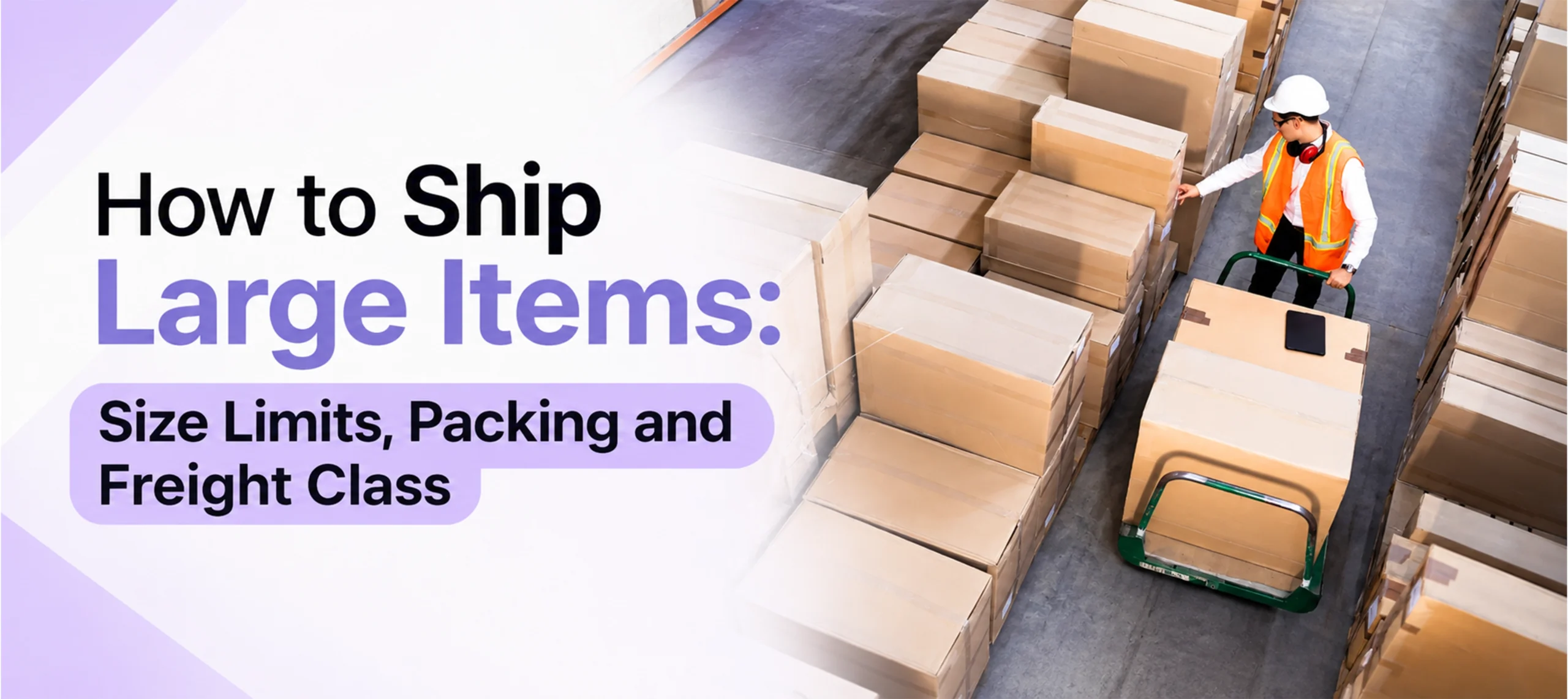
How to Ship Large Items: Size Limits, Packing and Freight Class
 By
How to ship large items starts with two numbers: the weight and the size of the packed box. In the US, as of September 2026, UPS and FedEx take packages up to 150 pounds and 165 inches in length plus girth as parcels. USPS stops at 70 pounds and 108 inches in length plus girth, or 130 inches for USPS Ground Advantage Retail. Past the UPS and FedEx limits, the item ships as freight. Well before them, a long or heavy box starts to pick up extra charges, so the box style and size you pick matter as much as the carrier.
Measure It the Way the Carrier Will
UPS’s size and weight guide sets out its method, and USPS defines length and girth the same way:
- Length is the longest side. Width is the next longest, height the shortest.
- Round each side up to the next whole inch.
- Work out the girth: twice the width plus twice the height.
- Add the length to the girth. That total is the number carriers set limits on.
- Measure an odd shape as if it were in a rectangular box, from its farthest points.
Measure the packed box, not the product, since the box is what the carrier measures. Our guide to length, width and height covers how box sizes are written.
A worked example: a box 60 by 20 by 12 inches has a girth of 64 inches (40 plus 24), so its length plus girth is 124 inches. That is under 130 inches, but its 60 inch length is already past the first UPS trigger in the table below.
Surcharges for Large Packages
These are the US thresholds on each carrier’s own pages, checked in September 2026. Surcharge amounts change, so only the triggers are shown.
| Carrier | Extra handling starts | Oversize or large package | Parcel maximum |
|---|---|---|---|
| UPS | Longest side over 48 in, second longest over 30 in, average weight over 50 lb, over 10,368 cubic inches, or not fully encased in corrugated (Additional Handling) | Over 96 in long, over 130 in length plus girth, over 17,280 cubic inches or over 110 lb, billed at a 90 lb minimum (Large Package) | 150 lb, 108 in long, 165 in length plus girth |
| FedEx | Not covered here | Over 96 in long or over 130 in length plus girth, 90 lb minimum billable weight | 150 lb and 165 in length plus girth; above either is freight |
| USPS | Not covered here | Not covered here | 70 lb; 108 in length plus girth, 130 in for Ground Advantage Retail |
Sources: UPS’s page on avoiding charge corrections, FedEx’s guide to shipping large items and the USPS Domestic Mail Manual. UPS does not add Additional Handling on top of a Large Package charge.
How to Pack a Large Item So It Passes
One UPS rule is easy to miss: a package “not fully encased in corrugated cardboard” can draw an Additional Handling charge. A product shipped in plastic wrap, or with parts sticking out of the box, can pay more. So the first packing rule is simple: corrugated all the way round.
FedEx’s own tips for large items add three more:
- Use a strong, new box. A used box may be weaker.
- Try a box inside a box, with cushioning between the two.
- Tape with the H method, using reinforced packing tape, not masking, duct or Scotch tape.
Inside the box, an insert holds the product in one position rather than letting it shift in transit. Our guide to packaging inserts covers the options. A heavier board resists crushing better in a parcel network, and the right stock depends on the product and the route; our guide “Corrugated Box Basics” explains the strength ratings.
Keep the box close to the product’s size. A bigger box costs more under dimensional weight, which our guide “How Much Does a Cardboard Box Weigh?” explains, and it can push a box over one of the triggers above.
When It Becomes Freight, and What Sets the Class
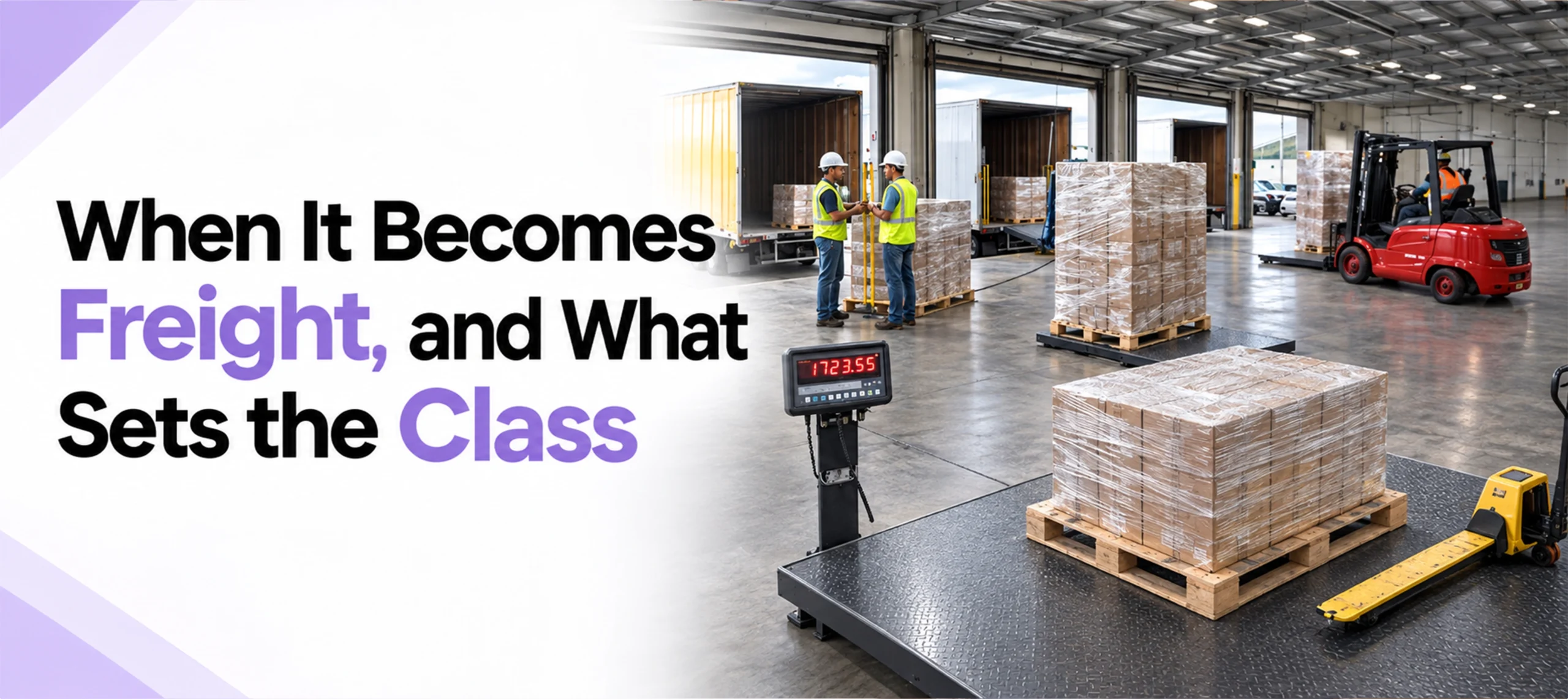
Over 150 pounds or 165 inches, UPS and FedEx treat the shipment as freight. UPS’s shipping FAQ describes less than truckload (LTL) freight as typically pallet freight over 150 pounds. For several boxes adding up to 151 pounds or more without a pallet, UPS says its Ground with Freight Pricing service may be an option.
In US LTL freight, the freight class comes from the National Motor Freight Classification. Its publisher, NMFTA, made a major update that took effect on July 19, 2025. It moved over 2,000 items to classes set by density, on a new 13 step scale.
Density is weight divided by cubic feet. NMFTA’s own example: a pallet 48 by 40 by 60 inches weighing 900 pounds is 66.67 cubic feet, or 13.5 pounds per cubic foot, which is class 85. Lower density means a higher class. For items classed by density, anything that adds cubic feet without adding weight, like a carton much bigger than the product inside it, pushes the class up.
Build a Pallet That Keeps Its Class
NMFTA’s September 2026 article A Leaning Pallet is a Reclassified Pallet explains why. LTL docks now use dimensioners, machines that measure the smallest box that fits around the whole load. The pallet counts, corner boards count, and so does any part of the load that has leaned or slid.
In NMFTA’s example, the same 900 pound pallet leaning about 10 degrees measures 48 by 50 by 59 inches, drops to 10.98 pounds per cubic foot, and moves to class 92.5. Nothing was added to it. NMFTA’s fixes:
- Stretch film with good cling, wrapped down onto the pallet itself, not just the boxes.
- Straps in both directions, at least two each way.
- Blocks against anything that can roll or slide.
- No extra height, from cones, top caps or cartons taller than the product.
If you want a lab test before you ship, ISTA publishes test procedures for both routes: 3A for parcel shipments of 150 pounds or less, and 3B for LTL shipments.
One Big Box or Several?
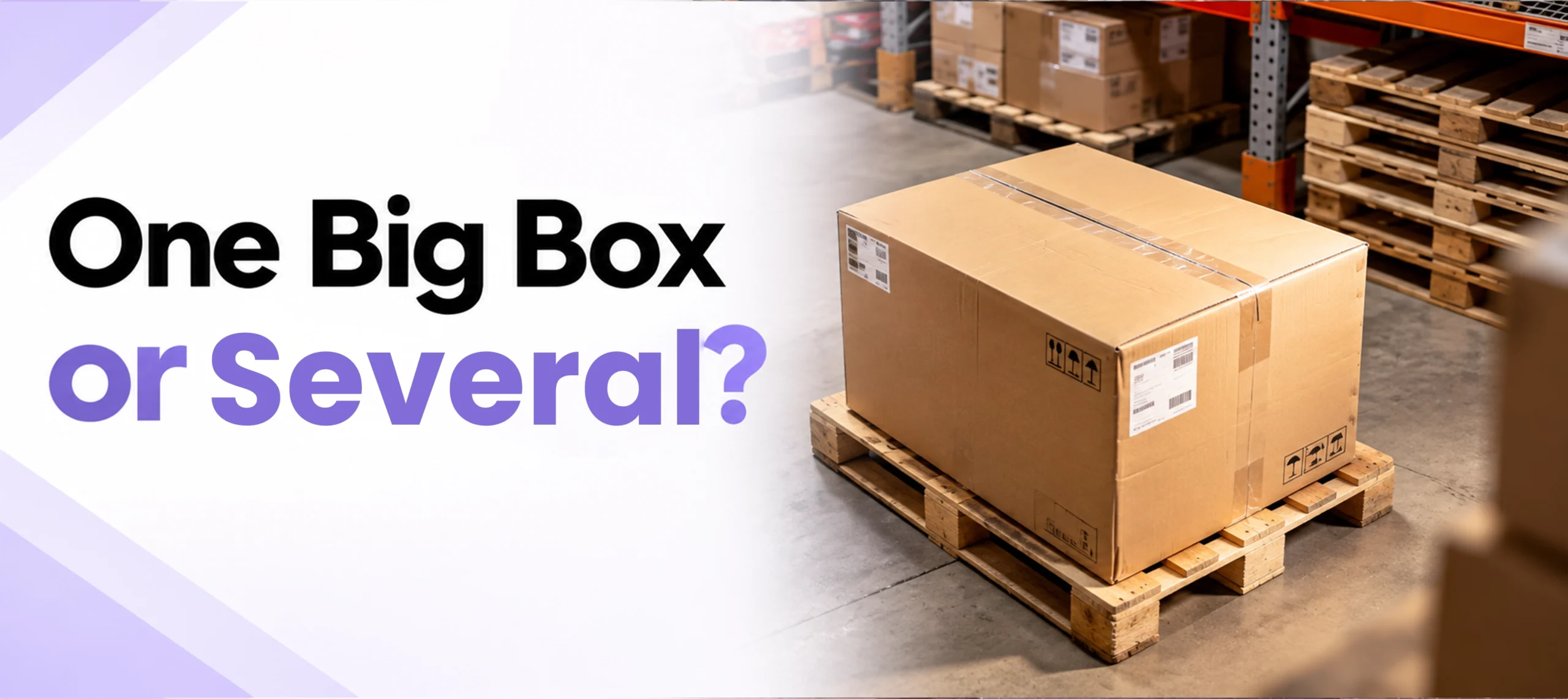
FedEx points out that splitting a shipment into several boxes can avoid large package fees, though each box pays its own rate, so it “may or may not be less expensive.” Price both ways before you pack.
Custom Boxes Deals makes corrugated boxes in single wall and double wall, made to your product’s dimensions, with the flute grade selected to suit the product and foam inserts where the specification calls for them. For a product that ships in sections, insert boxes keep each part in its place. Tell us the item’s size, weight and route, and we will suggest a construction.
Frequently Asked Questions
What is the biggest box UPS will take?
In the US as of September 2026, 150 pounds, 108 inches long and 165 inches in length plus girth. UPS says packages above its limits may need a freight service.
What is the largest package USPS accepts?
70 pounds and 108 inches in length plus girth, or 130 inches for USPS Ground Advantage Retail, per the Domestic Mail Manual.
At what length do surcharges start?
At UPS, a longest side over 48 inches or a second longest side over 30 inches can trigger Additional Handling, well before the 108 inch maximum.
Does packaging change a freight class?
For items now classed by density, yes. A bigger carton or a leaning load adds measured cubic feet without adding weight, which lowers density and raises the class.

Anthony Kim
Hello, I'm Anthony Kim, a seasoned packaging consultant and designer. With a professional journey spanning over four years, I've evolved from a budding designer to a recognized expert in the field. Currently holding the position of Packaging Consultant, I've honed my skills in creating not just visually stunning packaging but also solutions that align with strategic business goals.
View all articles →