Request Your Custom Quote
Tell us what you need. Our team normally replies within one business day.
Industries Using Rigid Boxes, and What Each Box Must Carry
 By
The industries using rigid boxes start with three. Wikipedia’s cardboard box entry names jewelry, electronics and gift items. The three supplier pages benchmarked for this post all add cosmetics. Two add apparel, and two add chocolates. In five of these industries, US rules reach the box itself: what it must carry, or what it may say. This post covers four of them, and cosmetics has its own guide. It is worth knowing before you design one.
What the Box May Have to Carry, by Industry
| Industry | What the box may have to carry | The rule |
|---|---|---|
| Apparel | Fiber content, country of origin and the maker’s name or RN, when the box hides the garment’s own labels | FTC, Textile Act rules |
| Jewelry | Nothing set, but any claim it makes about the piece | FTC Jewelry Guides, 16 CFR 23 |
| Electronics | The FCC ID or model details, when the device shows its FCC ID only on screen | FCC, 47 CFR 2.935(f) |
| Chocolates | The food’s name, net quantity and the rest of the food label, placed by panel | FDA, 21 CFR 101 |
| Cosmetics | Its own set of label rules | Covered in our cosmetic label requirements guide |
The rules below are the US texts as current on 1 October 2026.
Apparel: When the Box Has to Repeat the Label
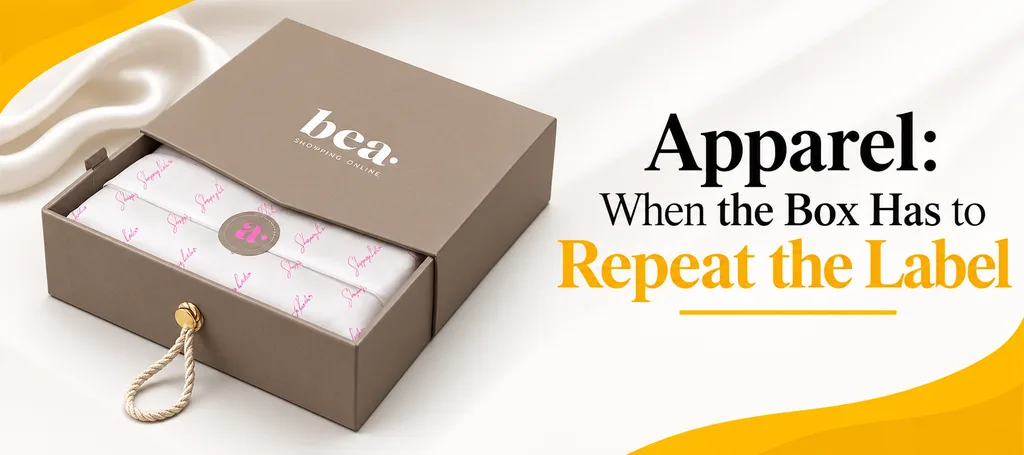
Garments carry their own labels for fiber content, country of origin and the maker. The FTC’s guide to the Textile and Wool Acts explains the rule for packaged products. The required information has to be “on each item in the package and on the package.” A transparent package is the exception. If a shopper can read the labels without opening it, it needs no label of its own.
A closed rigid box is not transparent. So a shirt, scarf or sweater sold in one generally needs its fiber content, origin and maker on the box, printed or on a label. The FTC names a second exception. The rule does not apply to items “packaged solely for mail order shipment.” A box packed only to be mailed to buyers falls outside it. A box that also sits on a store shelf does not.
If your apparel boxes will sell closed in stores, plan a panel or a label for this.
Jewelry: The Box Is Part of the Claim
The FTC’s Jewelry Guides do not tell you what to print on a jewelry box. They govern what you say. They cover claims “included in labeling, advertising, promotional materials, and all other forms of marketing.” Those claims can be made through “words, symbols, emblems, logos, illustrations, depictions, product brand names” or any other means. Words and images on the box count.
Take one example from the Guides. A diamond’s weight may be given in “points” only with a decimal part of a carat as well, such as “25 points or .25 carat.” If a box or its insert card states a weight, a metal or a stone, it falls under the same Guides as the tag. A plain box whose logo and name say nothing about the piece makes no such claim.
See jewelry boxes for the styles we make.
Electronics: Where the FCC ID Goes
A wireless device with a screen may show its FCC ID electronically instead of on a printed label. The US FCC allows that, with a condition in 47 CFR 2.935, current in 2026. Such a device must also be labeled “either on the device or its packaging.” The label gives the FCC ID, or a model number and the web page that holds its regulatory information. Printing on the packaging is one of the ways the rule lists. A removable label is allowed too. It has to survive shipping, and only the customer removes it, after purchase.
If your device has no physical FCC label, decide early whether the rigid box carries it. Users must also be told how to find the information on screen. That can go in the instructions, an insert in the packaging, or another easily accessible format.
Chocolates: The Lid Is a Label Panel
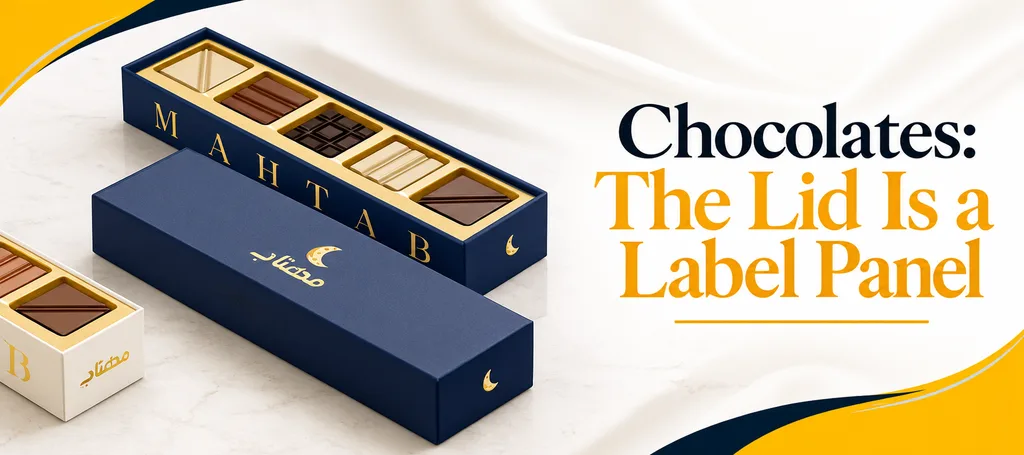
A box of chocolates sold at retail is food in package form. FDA’s label rules in 21 CFR 101 decide what goes where:
- The principal display panel is the part most likely to be seen on the shelf. It must carry the food’s name as one of its principal features.
- The net quantity sits on that panel too, in the lowest 30 percent of its area. A panel of 5 square inches or less does not have to follow that placement.
- The rest of the label goes on the principal display panel or the information panel. That includes the ingredients and the maker’s name and place of business.
- On a box whose top is the only display panel, the information panel is any panel next to it. On a lidded rigid box, those are the lid’s sides.
- Type must be at least one sixteenth of an inch high, unless an exemption in the rule applies.
Our guide to box design ideas covers the FTC’s parallel rule for many consumer goods that are not food, drugs or cosmetics. A box of chocolates follows FDA’s.
One change is pending. In January 2025, FDA proposed a compact nutrition box on the principal display panel of most foods that carry a Nutrition Facts label. A Federal Register search on 1 October 2026 showed no final rule.
A wrapped lid and its sides still have to leave room for all of this. Plan the panels before the artwork. See our chocolate boxes. Tell us what goes inside and we will confirm which materials suit it at quote.
Cosmetics
Cosmetic boxes carry their own US label rules for the outer box and the container inside. Our guide to cosmetic label requirements walks through them panel by panel, so they are not repeated here.
What This Post Does Not Cover
Footwear, wine and general gift boxes also appear on the supplier pages benchmarked for this post. We did not research box rules for them, so we make no claim either way. Parcel shipping and environmental claims are covered in the guide to the benefits of rigid boxes. For the box styles themselves, from telescopic to drawer and sleeve, see our overview of rigid box styles.
A Print Check Before You Order
- Apparel sold in stores: a panel for fiber content, origin and maker, unless shoppers can read the garment’s labels through the box or the box is packed only for mail order.
- Jewelry: every word or image on the box that describes the piece, checked against the Jewelry Guides.
- Electronics with an on screen FCC ID: the FCC ID or model and web page on the box, if not on the device.
- Chocolates: the food’s name on the display panel, net quantity in its bottom 30 percent, and the information panel next to it.
- Cosmetics: the cosmetic label rules, before artwork starts.
Custom Boxes Deals prints rigid boxes in CMYK or Pantone, with free design support. Send the label text with your artwork. You see a free 3D mockup before you approve production, so check each panel’s layout there. Check the wording against the rules above before you approve.
Frequently Asked Questions
Which industries use rigid boxes the most?
Wikipedia names jewelry, electronics and gift items. The supplier pages benchmarked for this post add cosmetics, apparel and chocolates. No source read for this post ranks industries by volume.
Does an apparel box need a fiber content label?
Yes, if the garment sells at retail in a closed box that hides its labels. The FTC’s guide says the package must then carry the required information too. Boxes packed only for mail order are exempt from that package rule.
Can a rigid box carry the FCC ID for a device?
Yes, for a device that shows its FCC ID on screen. 47 CFR 2.935(f) allows printing on the packaging as one way to label it.
Where does the net weight go on a chocolate box?
On the principal display panel, in its lowest 30 percent. A panel of 5 square inches or less does not have to follow that placement.

Anthony Kim
Hello, I'm Anthony Kim, a seasoned packaging consultant and designer. With a professional journey spanning over four years, I've evolved from a budding designer to a recognized expert in the field. Currently holding the position of Packaging Consultant, I've honed my skills in creating not just visually stunning packaging but also solutions that align with strategic business goals.
View all articles →