Request Your Custom Quote
Tell us what you need. Our team normally replies within one business day.
What Is Die Cutting? How Packaging Gets Its Shape
 By
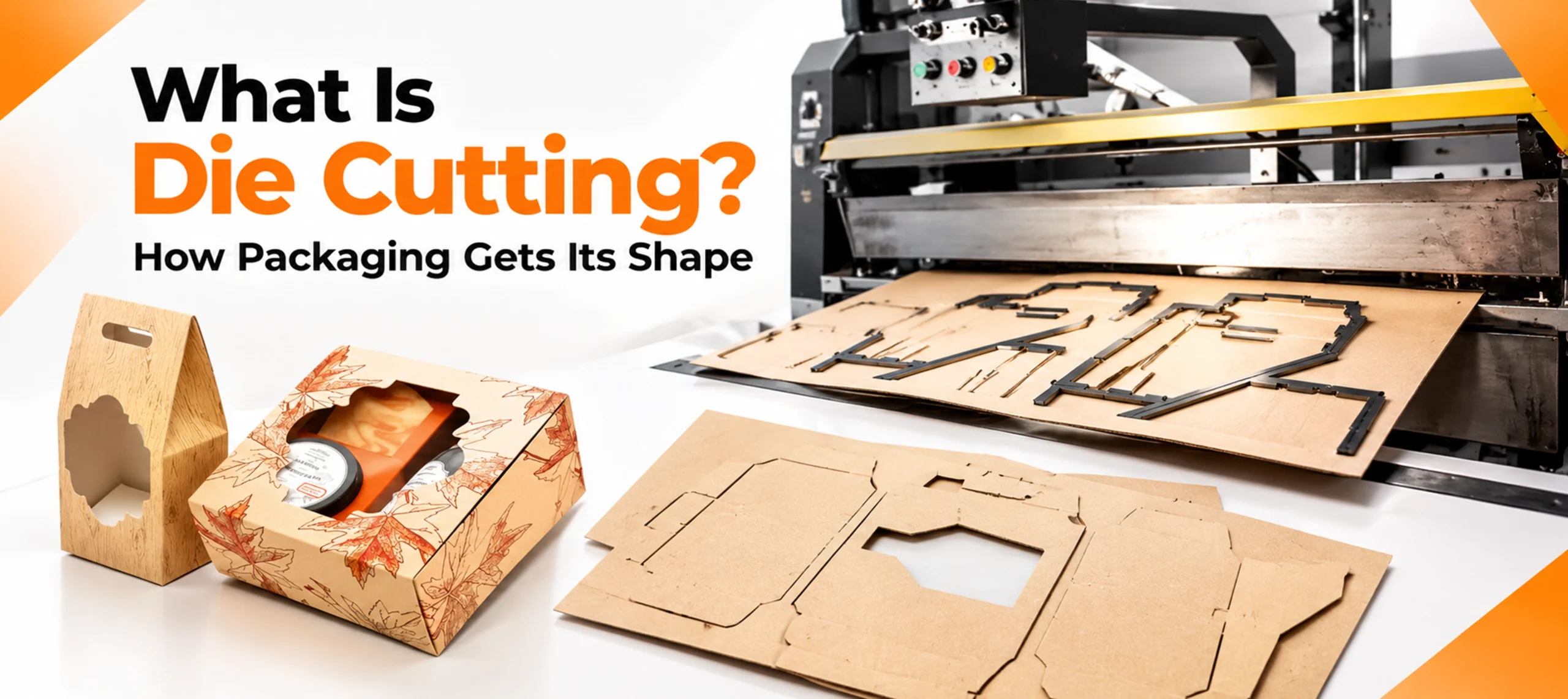
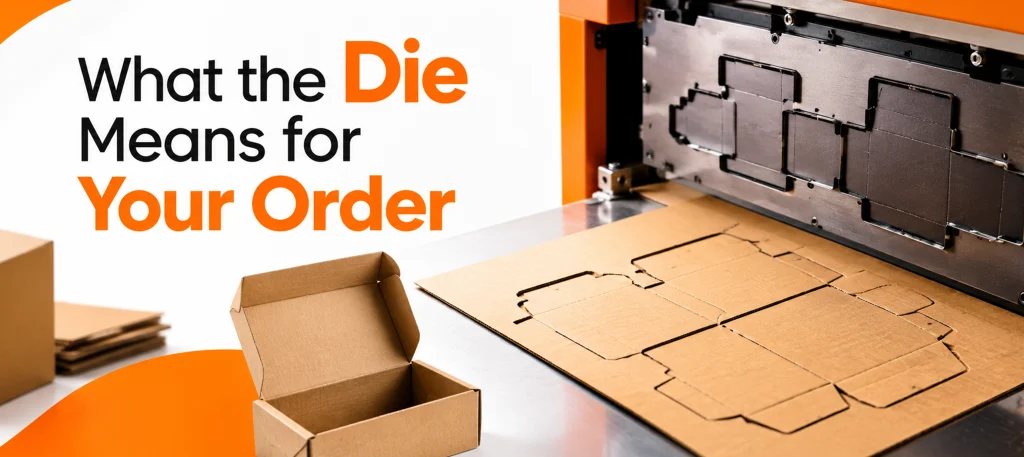
By So, what is die cutting? It is how a printed sheet of board becomes a flat box, ready to fold, and a die is a tool built from thin steel rules bent to the outline of the box and set into a board. When a press pushes it into the sheet, in one stroke it cuts the edges, presses in the fold lines and adds any perforations. The shape it follows is the dieline, the flat drawing of the box.
What the Rules on a Die Do
The steel rules are not all the same, and die maker Wink lists what its dies for cardboard and corrugated board are built to do:
| Line on the die | What it does to the sheet |
|---|---|
| Through cut | Cuts all the way through, for the outline and any holes |
| Crease | Presses a groove so the board folds cleanly |
| Perforation | A row of short cuts, for a tear strip or tear off tab |
| Kiss cut | Cuts the top layer only, used on sticky labels |
| Scribe | A shallow cut on the surface |
| Emboss | Raises a pattern without cutting |
A die board holds the rules; die makers also fit rubber around them, and opposite the die sits a counter plate with channels for the crease lines. Marbach, another die maker, sells counter plates and creasing channels as part of the same tool set.
How a Sheet Becomes Finished Blanks
A die cut job runs in a set order:
- Make ready. The die and counter plate are fitted to the press and adjusted until the cuts and creases come out right.
- Cut. Printed sheets feed through, and each press stroke cuts and creases one sheet, which can carry one box or several.
- Strip. The waste around and inside the shapes, like the holes for a window or a handle, is knocked out.
- Blank. The finished pieces, called blanks, are separated from each other.
Marbach lists separate stripping tools and blanking tools for those last two steps, and the blanks then go on to folding and gluing, or ship flat.
Flatbed, Rotary and Digital Cutting
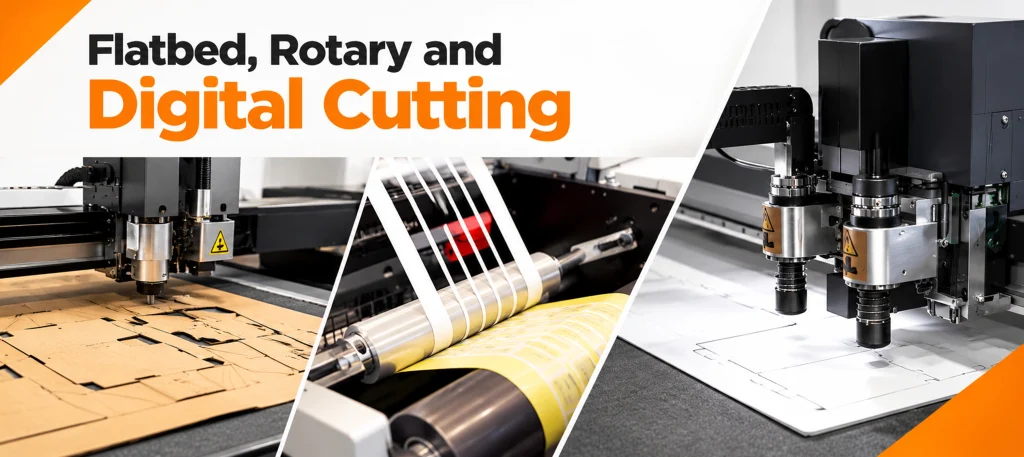
For corrugated board, FEFCO, the European corrugated board trade body, says die cut boxes are made on a rotary or flatbed die cutter that cuts and creases the board. Regular slotted boxes, FEFCO adds, are usually made another way, on a combined printer, slotter, folder and gluer rather than on a die cutter.
- Flatbed. A flat die presses down onto the sheet, one stroke at a time.
- Rotary. The die is curved around a cylinder and cuts as the sheet runs under it.
- Digital. There is no die at all: a computer guided knife or laser follows the dieline file, and Wink offers plotting and laser cutting for small series.
There is no single rule for which one handles intricate shapes better, so ask your supplier which machine your job will run on.
What Blanking Means in Packaging
Some packaging guides list the “types of die cutting” as blanking, drawing, forming, coining and broaching. Most of that list comes from sheet metal work. Wikipedia’s article on dies in manufacturing describes coining as squeezing metal into shape, drawing with a metal cup as the example, and broaching as cutting with rows of teeth. None of those happens to a carton.
Blanking is the one word the two trades share, and in both it means getting flat finished pieces out of a sheet. On a packaging die cutter, it is the step that separates the cut blanks from each other, as in the steps above.
Why Is It Called a Die?
The word came into English in the early 1300s for the gaming die, from Old French. According to Etymonline, the sense of a stamping tool, “used for stamping a softer material,” dates from the 1690s. Etymonline suggests the tool may have taken the name because such dies were often used in pairs, to stamp both sides of a coin.
What the Die Means for Your Order
- The die follows the dieline, not the artwork. Change the print and the same die still fits, but change the size or the structure and you need a new one.
- Many box features are die cut. Custom Boxes Deals makes die cut inserts, dividers and partitions, like those in insert boxes, plus integral carry handles, vents and windows. Shapes such as pillow boxes are die cut from the outline up.
- Ask about tooling up front. Ask whether a new die is charged separately, and whether it is kept for reorders, when you request a quote.
- Check the shape before the run. We produce in house, and you get a free 3D mockup before production approval, which is the time to catch a flap that folds the wrong way or a box style that does not suit the product.
Frequently Asked Questions
What is die cutting used for?
Cutting printed board into the flat shape of a box, with its fold lines, tear strips, windows and handles, in one press stroke.
What is the difference between a die and a dieline?
The dieline is the drawing, and the die is the steel tool built to match it.
Is die cutting the same as laser cutting?
No. Die cutting presses a steel rule tool into the sheet. Laser and knife cutters follow the file directly with no die. Wink, a die maker, offers them for small series.

Anthony Kim
Hello, I'm Anthony Kim, a seasoned packaging consultant and designer. With a professional journey spanning over four years, I've evolved from a budding designer to a recognized expert in the field. Currently holding the position of Packaging Consultant, I've honed my skills in creating not just visually stunning packaging but also solutions that align with strategic business goals.
View all articles →