
Request Your Custom Quote
Tell us what you need. Our team normally replies within one business day.
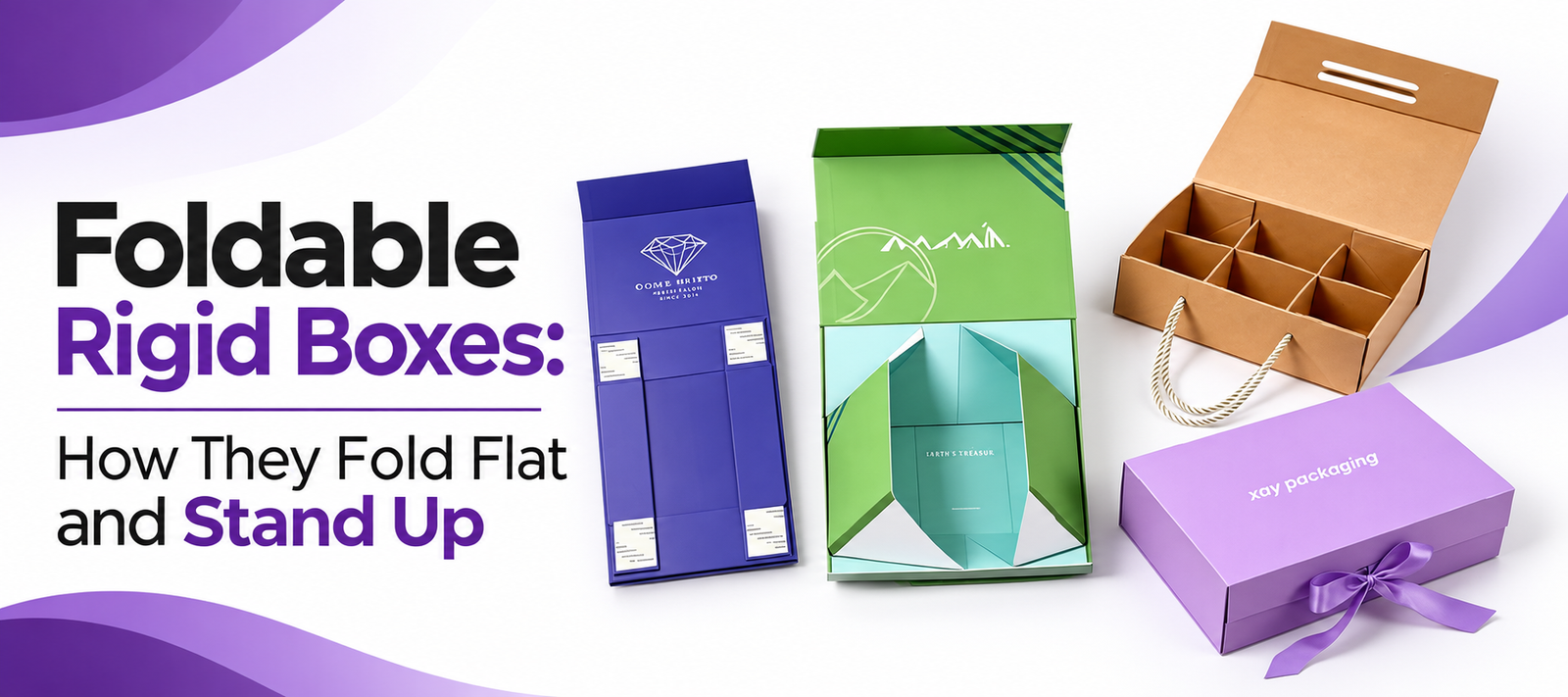
Foldable Rigid Boxes: How They Fold Flat and Stand Up
 By
Foldable rigid boxes, also called collapsible rigid boxes, are rigid boxes built to fold flat for shipping and storage. In the construction a US patent describes, the stiff board panels stop short of each other at the folds, and only the wrap crosses each fold, so the box can lie flat, then pull open into shape. Magnets or adhesive then hold it upright. You get the look of a rigid box without shipping and storing it full of air.
How the Fold Works
A standard rigid box is delivered fully built and does not fold flat. The foldable version gets round that with one idea, described in a US patent for a collapsible gift box published in 2010:
- Each panel is a rigid layer laminated in flexible sheets. The rigid layer can be cardboard, and the flexible layer can be paper, felt or decorative paper.
- At every fold, the rigid layers are spaced apart. The patent puts it plainly: the folding lines “only consist of flexible sheets.”
- So the wrap is the hinge. The patent calls for a flexible material “that can sustain continuous folding and unfolding.”
That is why the choice of wrap matters on a foldable box of this kind. It is not only the printed surface. It is the part that bends whenever the box folds or unfolds.
What Keeps a Foldable Rigid Box Standing
In the patent’s design, the side panels fold against center panels, and those center panels can be permanently attached to the front and back. Pull the front and back apart and the box opens; push them together and it collapses.
Something then has to hold it open. The patent lists the choices as “attachment means”: adhesives, glue, magnets, Velcro, rivets, pins or clasps. In practice that is a choice between two kinds of box:
| Closure | What it means |
|---|---|
| Removable, such as magnets | The box can be opened flat again and reused |
| Permanent, such as glue | The box is set once and stays set |
Magnetic closure boxes use magnets for the lid as well.
Why Brands Choose Foldable Rigid Boxes
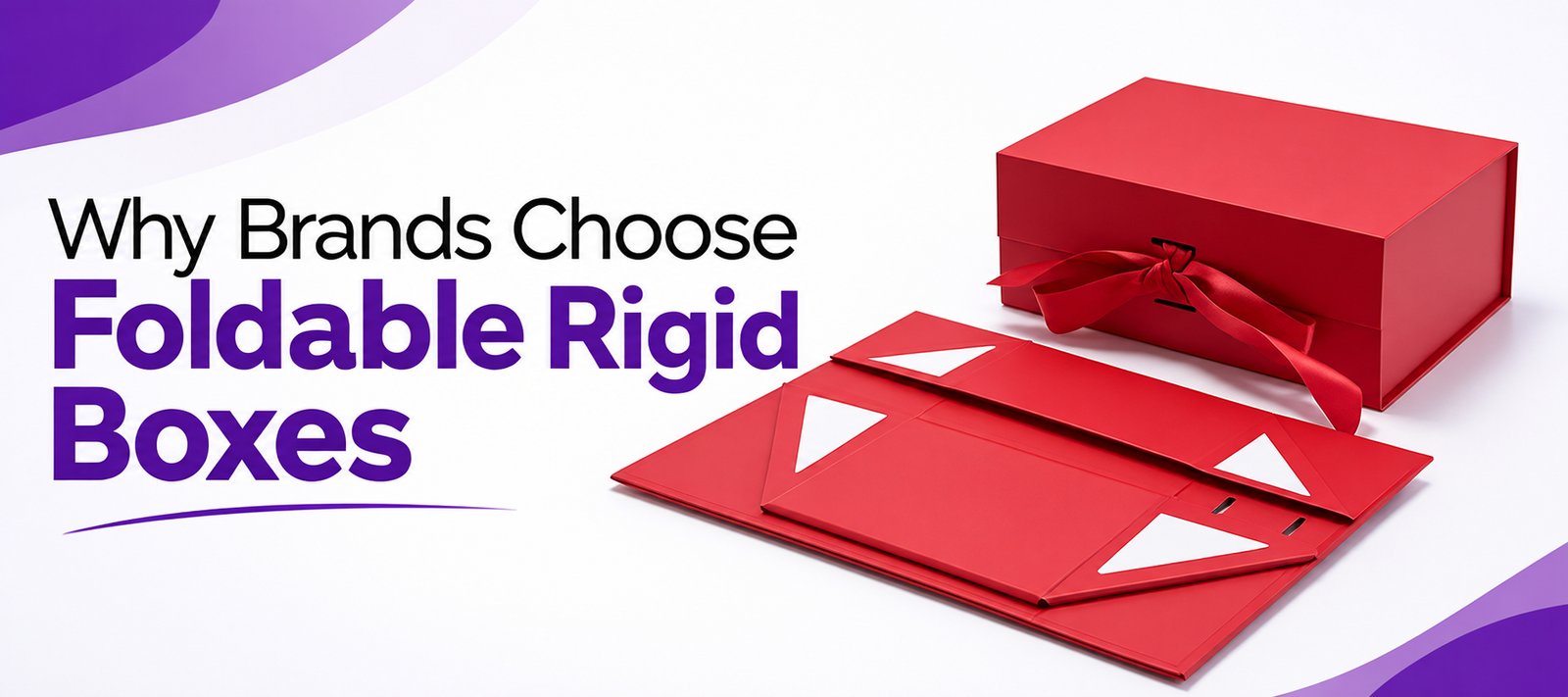
The patent’s own background explains the point. Boxes that arrive already built “require large amounts of space in order to be shipped, and are easily damaged during transit,” and they need “costly storage space” once they arrive. Flat sheets fix that: “a greater number of single flat sheets occupy the same volume” as one built box.
For a brand, that means fewer cartons of empty boxes arriving, and less shelf space holding them until they are packed.
Foldable, Standard Rigid or Folding Carton?
| Foldable rigid box | Standard rigid box | Folding carton | |
|---|---|---|---|
| Can it ship flat | Yes | No, it is delivered fully built | Yes |
| What it is made of | Board panels in a flexible wrap, hinged at the wrap (in the patented design) | A non bending grade of paperboard | Paperboard |
| Can it fold again | Yes, with a removable closure | No | Yes |
Wikipedia’s cardboard box entry notes that set up boxes, the standard rigid kind, “do not fold flat and are delivered fully constructed,” unlike folding cartons. Our guide to how rigid boxes are made walks through the standard build.
What to Specify When You Order
- The closure. Magnets for a box that opens flat again, or glue for one that is set once.
- Flat or built. Ships flat for assembly, or supplied pre assembled. Hand assembly does not generally require tools.
- The wrap. It is the hinge as well as the print surface, so choose it with folding in mind.
- An insert, if the product must not move. An insert holds the product in one position rather than letting it shift in transit.
- The size. Our guide to rigid box dimensions lists common sizes.
- The finish. Which finishes are available depends on the stock and the style you pick. Not every finish works on every material.
- The construction. The patented design spaces the board apart at each fold. Some supplier pages describe grooves or score lines cut into the board instead. Ask which one you are buying, since that decides what bends.
Custom Boxes Deals makes collapsible rigid boxes with magnetic or other closures and inserts where the product needs them. Tell us what goes inside and how the boxes will be stored, and we will suggest a build.
What the Evidence Does Not Settle
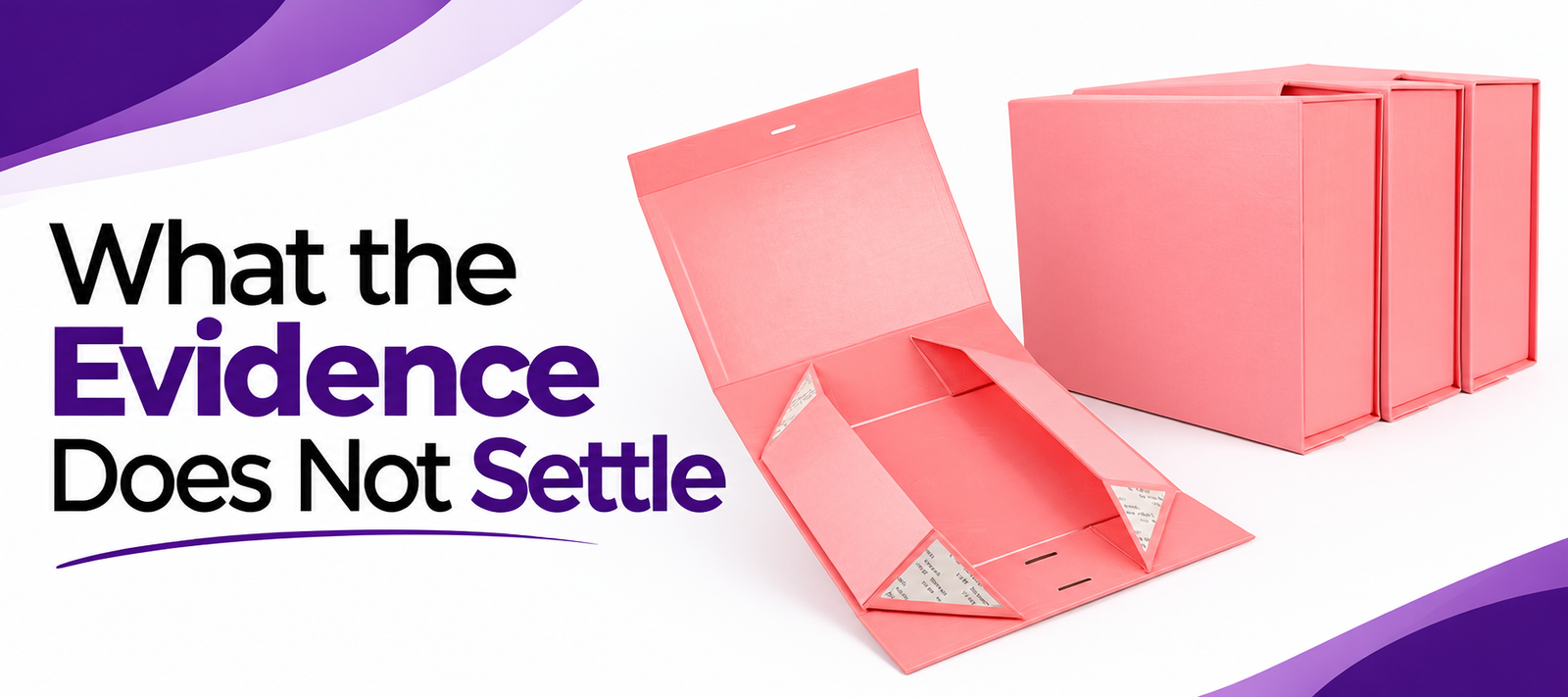
Two questions come up on the supplier pages we read, and neither has a source behind it yet. One is whether a foldable box costs more or less than a standard one; the source page for this post says both. The other is whether it is as strong; no test data was found. Ask for a sample and judge it in your own hands.
Frequently Asked Questions
Are foldable and collapsible rigid boxes the same thing?
Yes. They are two names for the same kind of box.
Why doesn’t the board crack when the box folds?
In the patented design, because the board does not fold. The panels stop short of each other at each fold, and only the flexible wrap bends. Boxes built another way, such as with grooved board, may bend differently, so ask your supplier.
Can a foldable rigid box be folded flat again?
Yes, if its closure is removable, such as magnets. A box set with permanent glue stays built.
Do foldable rigid boxes need tools to assemble?
Hand assembly does not generally require tools.

Anthony Kim
Hello, I'm Anthony Kim, a seasoned packaging consultant and designer. With a professional journey spanning over four years, I've evolved from a budding designer to a recognized expert in the field. Currently holding the position of Packaging Consultant, I've honed my skills in creating not just visually stunning packaging but also solutions that align with strategic business goals.
View all articles →