Request Your Custom Quote
Tell us what you need. Our team normally replies within one business day.
Cosmetic Label Requirements, Panel by Panel: Box vs Bottle
 By
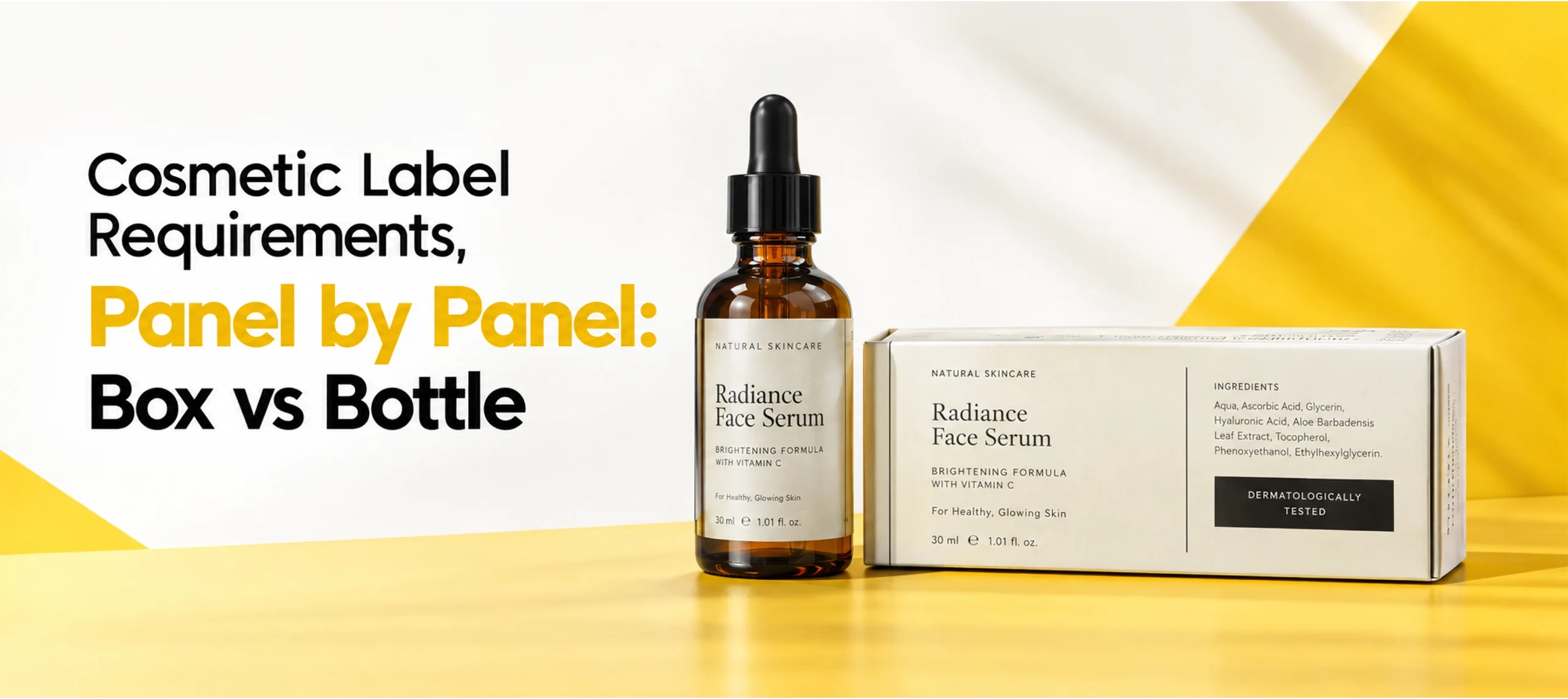
By A US cosmetic sold in a carton needs words in two places. The front of the box carries the product name, what the product is, and the net contents. The sides and back carry the ingredient list, the company name and address, and any warnings the product needs. A contact line for reporting bad reactions must be on the box too. The bottle or jar inside still needs its own name, company details and net contents, plus any directions and warnings that apply. Those are the core cosmetic label requirements in 2026. The size of your custom cosmetic boxes then decides how large some of that type must be.
First, Check That the Product Is a Cosmetic
Under US rules in 2026, some beauty products are drugs. An SPF moisturizer, an antiperspirant and a dandruff shampoo are common examples. They carry a Drug Facts panel under drug rules, with the active ingredients listed first. True soap is different again. A bar made mostly of fatty acid salts, labeled and sold only as soap, with no claim beyond cleansing, is regulated by the Consumer Product Safety Commission, not FDA. A bar that also claims to moisturize or treat the skin falls back under FDA as a cosmetic or a drug. FDA’s own page on the split sets out the test. Everything below applies to products that are cosmetics and nothing else.
The Front of the Box
When a product sits in a carton, the carton front is the principal display panel. FDA’s labeling guide says plainly that only the outer container has one. The bottle inside does not. The mailer an online order ships in is not part of this. FDA’s guide defines the package as the container a product is delivered or displayed in, other than a shipping container, so the required text goes on the retail carton, not the mailer.
That front panel carries two required items. The first is the identity statement: what the product is, such as “hand cream” or “lip gloss.” It goes in bold type, sized in step with the largest print on the panel, running parallel to the base the box stands on. The second is the net contents. Creams and solids are stated by weight in ounces. Liquids are stated in fluid ounces.
The net contents must stand apart from other text, in bold, inside the bottom 30 percent of the panel. A box with two display faces, such as a front and a back that both face shoppers, repeats both items on each face. If a product’s safety has not been substantiated, FDA’s warning for that case goes on this front panel too.
Metric deserves a plain answer. FDA’s own cosmetic rule, 21 CFR 701.13, still says a metric figure “may” appear. The federal packaging law itself says more. Since a 1992 amendment, 15 U.S.C. 1453 has required both US units and metric units on the net contents. Print both, such as “1.7 fl oz (50 mL).” It costs a few characters and follows the statute.
How Large the Net Contents Type Has to Be
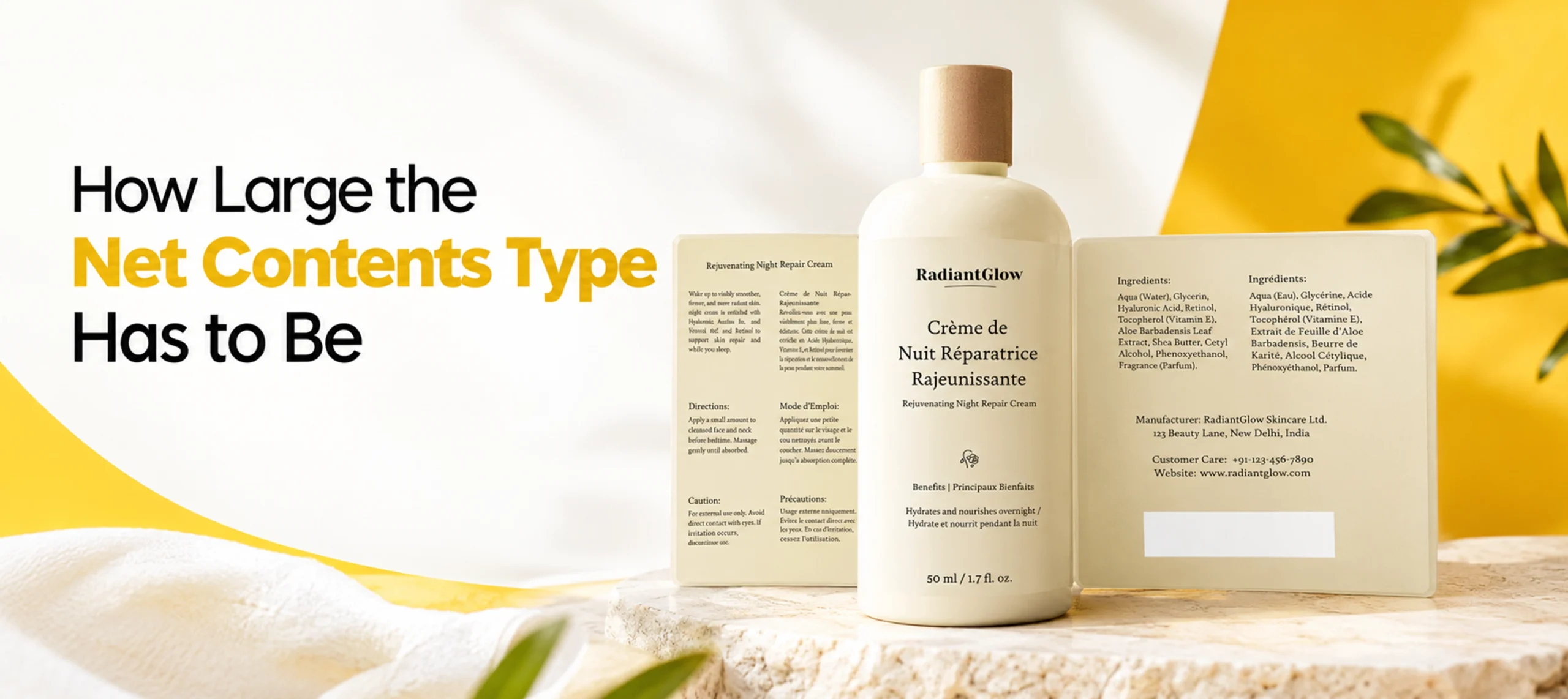
The minimum height of the net contents is set by the area of the front panel. On a rectangular box, that area is the height times the width of the front. On a tube or bottle, it is 40 percent of the height times the circumference.
| Front panel area | Minimum letter height for net contents |
|---|---|
| 5 square inches or less | 1/16 inch |
| Over 5, up to 25 square inches | 1/8 inch |
| Over 25, up to 100 square inches | 3/16 inch |
| Over 100 square inches | 1/4 inch |
| Over 400 square inches | 1/2 inch |
Three worked examples show why box size matters before artwork starts. A slim carton for custom lipstick boxes, one inch wide and 3.25 inches tall, has a 3.25 square inch front. Its net contents need letters at least 1/16 inch high. At 5 square inches or less, the bottom 30 percent rule also stops applying. A lotion carton two inches wide and six inches tall has a 12 square inch front, so the minimum doubles to 1/8 inch. An 8 by 10 inch gift box needs 3/16 inch.
Two details catch people out. When lowercase letters are used, the measurement is taken on the lowercase “o,” not the capitals. And net contents molded or embossed into a glass or plastic container, rather than printed, must be 1/16 inch taller than the table shows. A 3D mockup of custom lotion boxes is a good moment to measure the printed carton lettering.
The Sides and Back of the Box
The sides and back are the information panels. Four things usually live here.
The ingredient list. It goes on any information panel, in letters at least 1/16 inch high. Ingredients are listed by their standard names, in descending order of amount. Anything at 1 percent or less may follow in any order, and color additives may come last. A blend of scent may be listed simply as “fragrance,” which is still allowed as of September 2026.
The company name and address. This is the name of the maker, packer or distributor. If the brand did not make the product, the name carries a phrase such as “Distributed by” or “Manufactured for.” The address needs street, city, state and ZIP code. The street may be left out if the company appears in a current city or telephone directory. For imported products, FDA’s summary notes that the Tariff Act of 1930 requires the country of origin in English.
Warnings. Certain products must carry set wording under 21 CFR Part 740, in force in the US in 2026. Examples include aerosol sprays, feminine deodorant sprays, bubble bath and other foaming bath products unless labeled for adults only, some coal tar hair dyes, and tanning products without sunscreen. Every warning must be bold, on a contrasting background, and at least 1/16 inch high.
The adverse event contact line. Since December 29, 2024, every cosmetic label must include a domestic address, a domestic phone number, or electronic contact details such as a website. This is where people report bad reactions. It comes from the 2022 law known as MoCRA, now 21 U.S.C. 364e. One more federal rule decides where it goes. Under 21 U.S.C. 321(k), any required label text must also appear on the outer carton, or be readable through it. A contact line printed only on the bottle, hidden inside a closed carton, does not meet that rule. It belongs on the box as well.
What the Bottle or Jar Inside Still Needs
A carton does not free the bottle from its own label. FDA’s guide lists what the inner container must still carry: the product name, the company name and address, and the net contents, plus directions for safe use and warnings wherever the product needs them. The ingredient list is the main item that can stay on the carton alone.
The net contents rule relaxes on the inside, but it does not disappear. When both the carton and the bottle carry the required text, and the bottle is not sold on its own, the bottom 30 percent placement rule is waived for the bottle. The statement itself still has to be there.
Plan for a store removing the carton. If a retailer displays the bottle without its box, FDA treats the bottle’s label as the outer label. It then needs everything the carton carried, ingredients included.
Small Products and Gift Sets
Lip balm and other tiny products get two allowances. When the total surface available for labeling is under 12 square inches, ingredient letters may shrink to 1/32 inch. And some small products may put the ingredient list on a leaflet or a display card instead of the package. That second option closes the moment the product sits in a folding carton. Once a balm has its own box, such as custom lip balm boxes, the carton carries the ingredient list.
Gift sets work the other way. Each item inside a set can skip its own ingredient list, as long as the set’s outer label covers everything and the items are not meant to be sold one by one. A fragrance collection in custom perfume boxes can therefore list the whole set on the outer box. The color additives of an assortment may also share one combined list.
The One Requirement Still Moving: Fragrance Allergens
MoCRA also requires brands to name each fragrance allergen on the label. It left the list of which substances count to an FDA regulation. That proposal was due 18 months after the law passed, which was June 2024. As of September 26, 2026, no proposed rule appears in the Federal Register, and FDA’s MoCRA page still lists allergen labeling as a US regulation to be written. FDA’s most recent regulatory agenda entry for the rule, from fall 2025, targets November 2026 for the proposal. An earlier entry targeted October 2024, and that date passed without one.
Until that rule exists, “fragrance” remains a valid ingredient entry. When it arrives, the label text will need to change. The law says the allergens go on the label, without naming a panel. Keeping required text on the side panels, apart from the front artwork, keeps a future text change away from the design. The same thinking helps when a formula changes, since the ingredient list must always match what is in the product.
Who Answers for What Is on the Label
The label content is the brand’s responsibility. MoCRA calls the company named on the label the responsible person. That company decides the wording, confirms the ingredient list, and receives the adverse event reports.
A box maker prints the artwork the brand approves. At Custom Boxes Deals, design support is free, so the panels can be laid out around the type sizes and text your label needs. Our minimum order is 100 boxes. Where those panels sit is fixed on the dieline, so give us the final wording before layout starts. Before you approve production, you get a free 3D mockup, and that is the moment to check that every required line fits and reads clearly. Your dieline, specification and approved artwork are retained, so a repeat order runs from the same files.
Frequently Asked Questions
Do cosmetics need an expiration date in the US?
No. FDA’s page, checked in September 2026, states that no US law or regulation requires expiration dates on cosmetics. Products that are both cosmetics and drugs, such as an SPF moisturizer, must carry one. FDA’s shelf life page explains the difference.
Does the ingredient list have to go on the jar as well as the box?
Not when the jar stays in its carton and is not sold alone. If the jar is ever displayed or sold without the carton, its own label must carry the ingredients.
What changes for products sold only to salons?
Products meant only for licensed professionals must say clearly that only licensed professionals should use them. Products used on clients and not sold for home use can skip the ingredient list, according to FDA’s summary of the rules.
Can a brand still write “fragrance” instead of listing each scent ingredient?
Yes, as of September 2026. That will change once FDA issues its fragrance allergen rule, which has not yet been proposed.

Anthony Kim
Hello, I'm Anthony Kim, a seasoned packaging consultant and designer. With a professional journey spanning over four years, I've evolved from a budding designer to a recognized expert in the field. Currently holding the position of Packaging Consultant, I've honed my skills in creating not just visually stunning packaging but also solutions that align with strategic business goals.
View all articles →