Request Your Custom Quote
Tell us what you need. Our team normally replies within one business day.
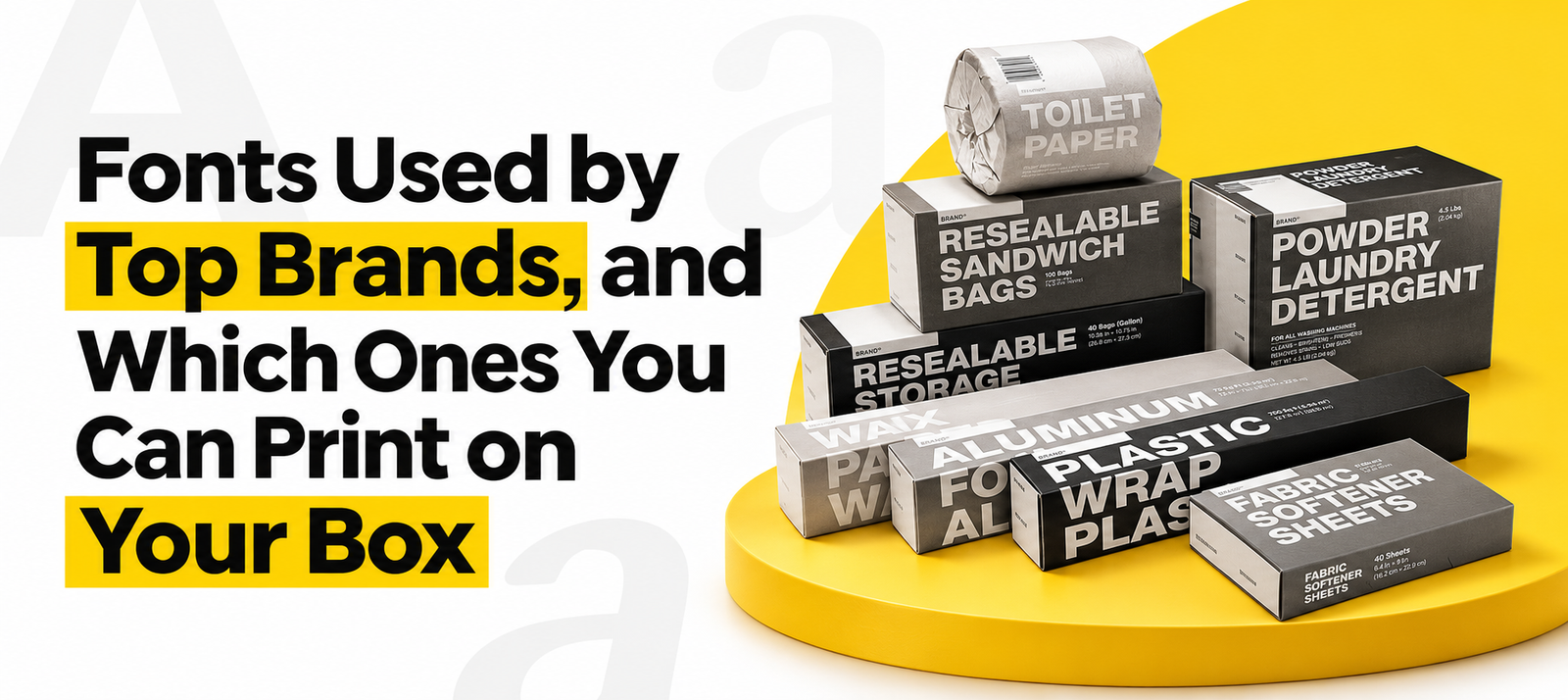
Fonts Used by Top Brands, and Which Ones You Can Print on Your Box
 By
Several fonts used by top brands are typefaces the brand had made for itself, or lettering it treats as a trademark. Apple uses San Francisco, which it designed. Google sets its logo in a custom typeface and puts Product Sans beside it, a font it keeps for its own products. IBM uses IBM Plex, which anyone can use under an open license. Coke’s script is lettering first written out by hand, which the company calls a trademark. Published lists do not always agree, so check the brand’s own page. Then, for your own packaging, such as custom logo mailer boxes, pick a font you are licensed to print and set it large enough to read.
Fonts Used by Top Brands, Checked Against Their Own Pages
| Brand | Typeface | What the brand says | Can you print it on your box? |
|---|---|---|---|
| Apple | San Francisco (SF Pro) | Apple designed it; SF Pro is “the system font for Apple platforms” | Apple offers it for designing apps on its platforms. Read its license before any other use |
| Google, logo | Custom typeface | The logo is set in a custom geometric sans serif typeface | No. It is Google’s logo |
| Google, product names | Product Sans | Made to sit beside the logo in product lockups | No. Google says it is only for Google products, by Google |
| Google Sans | Only for Google until November 2025 | Yes, under the SIL Open Font License | |
| IBM | IBM Plex | IBM’s “corporate typeface family” | Yes, under the SIL Open Font License |
| Coke | Spencerian script | Written out by Frank M. Robinson, the partner of the drink’s creator; “a distinctive and unique trademark” | No. The company calls it a trademark |
Sources: Apple’s fonts page, Google’s identity page from its design team, the Google Fonts FAQ, IBM Plex on GitHub and Coke’s own trademark history, all read in October 2026.
Why Brand Font Lists Disagree
- Fonts change. Creative Bloq traced Apple from Apple Garamond to Myriad in 2002, then to San Francisco. Google Sans opened to everyone in November 2025, yet a March 2026 list from MadeGood Designs still says you cannot license it.
- Lists contradict each other. For Starbucks, Packlane calls the logo font custom and hand drawn, and also names it as Freight Sans Black. MadeGood Designs names Freight Sans and Sodo Sans as its brand typefaces. Starbucks’ own type page did not load for this guide, so we name neither.
Three Ways to Get a Brand Font for Your Packaging
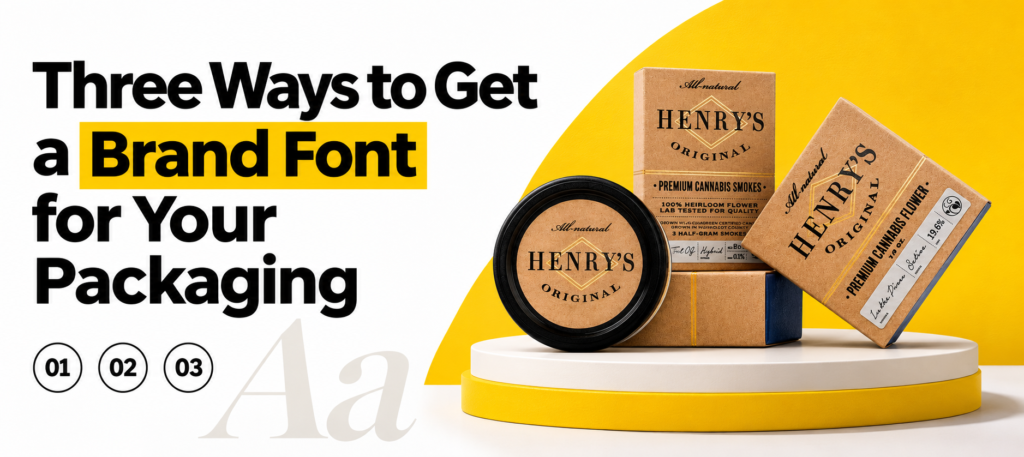
- Open fonts. Google Fonts says its fonts can be used commercially, in a logo, in print and “on any surface”. The most common license there is the SIL Open Font License, which lets you use a font freely as long as you do not sell the font by itself.
- Licensed fonts. A commercial font comes with a license from the company that sells it. Check that it covers print, packaging and logo use before your box goes to press.
- Custom fonts. A custom font is drawn for one brand, as San Francisco, Product Sans and IBM Plex were. The brand then decides who else may use it. Google keeps Product Sans to itself, while IBM opened Plex to everyone.
What US Rules Protect, and What They Do Not
US copyright rules, as read in October 2026, list “Typeface as typeface” among things not subject to copyright, along with mere variations of lettering (37 CFR 202.1). That does not make every font free. The font file comes with its own license; IBM’s calls the file “Font Software” and sets the terms. A logo’s lettering can also be a trademark, as Coke says its script is. So do not copy a famous brand’s logo lettering onto your box, even with a font that looks close. This is general information, not legal advice.
Fonts on a Food or Drink Box
If your box carries a US food label, any font you choose has rules to meet:
- Size. Required text on the principal display panel (the front) and the information panel must be at least 1/16 inch tall, unless an exemption applies (21 CFR 101.2(c)).
- Shape. A letter may be no more than 3 times as high as it is wide (21 CFR 101.7(h)(1)). A very condensed display font can fail this.
- How it is measured. When text uses lowercase letters, the lowercase “o” must meet the minimum (21 CFR 101.7(h)(2)).
The net quantity line has its own minimums, set by the area of the front panel: 1/16 inch when that panel is 5 square inches or less, and more on larger panels (21 CFR 101.7(i)).
How to Choose a Font for Your Packaging
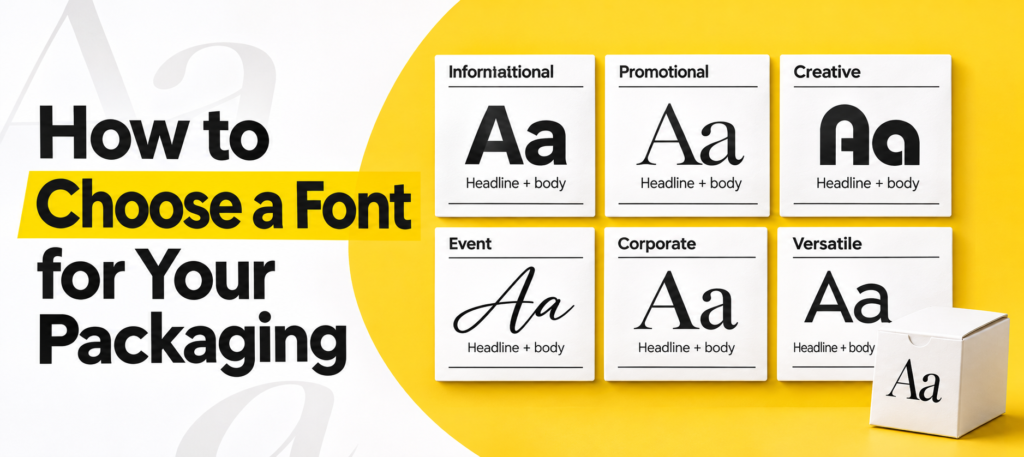
- License. Confirm it covers packaging and logo use.
- Size. Check the smallest required line on a printed proof, not only on screen.
- Shape. Keep very condensed or thin script fonts for display words, not required text.
- Placement. Look at where folds and cuts fall on the dieline before you place small text.
- Finish. If your name will be foil stamped or embossed or debossed, plan the lettering with that finish in mind.
Printing Your Brand Font at Custom Boxes Deals
Printing is CMYK, Pantone or PMS, or unprinted. Design support is free, with no design fees. Before production approval, you see a free 3D mockup. Send your artwork and we will tell you how it will reproduce on the stock you have picked.
Frequently Asked Questions
What fonts do top brands use?
Of the brands checked here, Apple uses San Francisco, Google pairs a custom logo with Product Sans, and IBM uses IBM Plex. Coke’s script is handwritten lettering the company calls a trademark.
Can I use the same font as a famous brand?
Only if its license allows it. Google Sans and IBM Plex are open to everyone. Product Sans is for Google only.
What font does Google use for its logo?
A custom geometric sans serif typeface, according to Google. Product Sans was made to go with it.
Are fonts protected by copyright in the US?
A typeface design as such is not subject to copyright (37 CFR 202.1(e)). The font file still comes with a license, and a logo can be a trademark.
How small can text be on a food box?
Unless an exemption applies, required text on the main panels must be at least 1/16 inch tall. For lowercase text, the letter “o” is what gets measured (21 CFR 101.2(c) and 101.7(h)).

Anthony Kim
Hello, I'm Anthony Kim, a seasoned packaging consultant and designer. With a professional journey spanning over four years, I've evolved from a budding designer to a recognized expert in the field. Currently holding the position of Packaging Consultant, I've honed my skills in creating not just visually stunning packaging but also solutions that align with strategic business goals.
View all articles →